Adapters
Civitas provides adapters (via civitas-contrib) that wrap third-party agent frameworks as AgentProcess instances. A wrapped agent gains Civitas's supervision tree, transport-agnostic messaging, and automatic OTEL tracing — without rewriting the underlying framework code.
What an adapter gives you
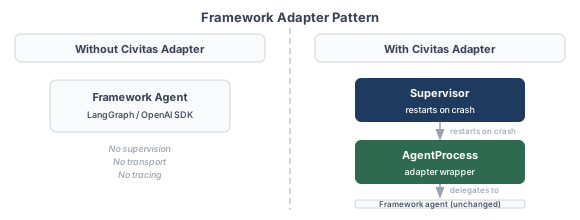
The adapter is a thin shell. The framework agent runs inside handle(). If it raises an unhandled exception, the supervisor restarts it exactly as it would any native AgentProcess.
LangGraphAgent
Wraps a LangGraph CompiledGraph as an AgentProcess. The graph receives message.payload as its input state and its output dict becomes the reply payload.
Install:
Basic usage:
from langgraph.graph import StateGraph, END
from typing import TypedDict

from civitas import Runtime, Supervisor
from civitas_contrib.adapters.langgraph import LangGraphAgent


# Define your LangGraph graph as usual
class State(TypedDict):
    question: str
    answer: str

def answer_node(state: State) -> State:
    return {"answer": f"Answer to: {state['question']}"}

graph = StateGraph(State)
graph.add_node("answer", answer_node)
graph.set_entry_point("answer")
graph.add_edge("answer", END)
compiled = graph.compile()


# Wrap it in an Civitas adapter — one line
runtime = Runtime(
    supervisor=Supervisor(
        "root",
        children=[
            LangGraphAgent("my_graph", graph=compiled),
        ],
    )
)
Calling the agent from another agent or from the runtime:
response = await runtime.ask("my_graph", {"question": "What is Civitas?"})
print(response.payload["answer"])
With typed input validation:
Pass input_schema to coerce the message payload through a typed dict before the graph runs. This catches payload mismatches early with a clear error rather than a deep LangGraph ValidationError:
LangGraphAgent(
    "my_graph",
    graph=compiled,
    input_schema=State,   # validates payload keys and types before ainvoke()
)
How it works:
async def handle(self, message: Message) -> Message | None:
    payload = self._input_schema(**message.payload) if self._input_schema else message.payload
    output = await self._graph.ainvoke(payload)
    return self.reply(output if isinstance(output, dict) else {"output": output})
The graph's ainvoke() is called with the message payload. Non-dict outputs (e.g. a string from a simple graph) are wrapped in {"output": value} automatically.
Supervision in action:
If the LangGraph graph raises an unhandled exception — network error, LLM timeout, validation failure — the exception propagates to on_error(), which escalates to the supervisor. The supervisor applies its backoff policy and restarts LangGraphAgent. The graph itself is stateless (the compiled object is not mutated), so restart is safe.
Subclassing for retry logic:
The adapter's on_error() escalates by default. Override _is_transient() to retry on specific errors:
import httpx
from civitas_contrib.adapters.langgraph import LangGraphAgent

class ResilientGraphAgent(LangGraphAgent):
    def _is_transient(self, error: Exception) -> bool:
        # Retry on network timeouts; escalate everything else
        return isinstance(error, httpx.TimeoutException)
Limitations:
- LangGraph's built-in
MemorySaver/SqliteSavercheckpointing runs independently of Civitas'sStateStore. If you use LangGraph checkpointing, the graph's internal state is managed by LangGraph;self.statein the adapter is separate. - LangGraph streaming (
graph.astream()) is not forwarded through Civitas's message protocol. The adapter waits forainvoke()to complete and replies once. If you need streaming, do it inside the graph node itself. - LangGraph human-in-the-loop interrupts (
interrupt()) pause the graph insideainvoke(). The adapter will block until the interrupt is resolved. Use a shortask()timeout at the caller and design your interrupt resolution flow accordingly.
OpenAIAgent
Wraps an OpenAI Agents SDK Agent as an AgentProcess. Incoming messages must include an "input" key. The agent's final text output is returned as {"output": ...}. Handoffs are mapped to Civitas send() calls.
Install:
Basic usage:
from agents import Agent
from civitas import Runtime, Supervisor
from civitas_contrib.adapters.openai import OpenAIAgent

# Define your OpenAI agent as usual
assistant = Agent(
    name="assistant",
    instructions="You are a helpful assistant. Answer concisely.",
)

# Wrap it
runtime = Runtime(
    supervisor=Supervisor(
        "root",
        children=[
            OpenAIAgent("assistant", agent=assistant),
        ],
    )
)
Sending a message:
response = await runtime.ask("assistant", {"input": "What is the capital of France?"})
print(response.payload["output"])   # "Paris."
Handoffs between agents:
If the OpenAI agent hands off to another agent, the handoff is translated to an Civitas send() call — the target agent must be registered in the supervision tree:
from agents import Agent, handoff

researcher = Agent(name="researcher", instructions="Search and return facts.")
writer = Agent(
    name="writer",
    instructions="Write a summary based on research.",
    handoffs=[handoff(researcher)],
)

runtime = Runtime(
    supervisor=Supervisor(
        "root",
        children=[
            OpenAIAgent("writer", agent=writer),
            OpenAIAgent("researcher", agent=researcher),
        ],
    )
)
When writer hands off to researcher, the adapter calls await self.send("researcher", {"input": ...}). If researcher is not registered in Civitas, a warning is logged and execution continues — it does not crash:
How it works:
async def handle(self, message: Message) -> Message | None:
    from agents import Runner

    user_input = message.payload.get("input")
    if user_input is None:
        return self.reply({"error": "payload must include 'input' key"})

    result = await Runner.run(self._agent, input=user_input)

    # Map handoffs to Civitas send() calls
    for item in getattr(result, "new_items", []):
        if hasattr(item, "agent") and hasattr(item, "input"):
            await self.send(item.agent.name, {"input": item.input})

    return self.reply({"output": result.final_output})
Subclassing for transient error retry:
from openai import RateLimitError
from civitas_contrib.adapters.openai import OpenAIAgent

class ResilientOpenAIAgent(OpenAIAgent):
    def _is_transient(self, error: Exception) -> bool:
        return isinstance(error, RateLimitError)
Limitations:
- The adapter uses
Runner.run()(non-streaming). Streaming responses are not propagated via Civitas messages. - OpenAI Agents SDK tool calls are executed inside the
Runner— they are not exposed as CivitasToolProvidercalls and do not generate Civitas tool spans. - Handoff target names must match the
namefield of theAgentProcessregistered in Civitas, not theAgent.namefrom the OpenAI SDK (which may differ).
CrewAIAgent
Coming soon
CrewAIAgent is not yet implemented. The class exists as a placeholder and raises NotImplementedError on instantiation. Track progress or upvote the issue at github.com/civitas-io/civitas-contrib/issues.
When available, it will wrap a CrewAI Crew as an AgentProcess, providing the same supervision, transport, and tracing benefits as LangGraphAgent and OpenAIAgent. The planned interface:
from civitas_contrib.adapters.crewai import CrewAIAgent

runtime = Runtime(
    supervisor=Supervisor(
        "root",
        children=[
            CrewAIAgent("my_crew", crew=my_crew),
        ],
    )
)

response = await runtime.ask("my_crew", {"task": "Research quantum computing"})
What the adapter pattern gives you
Both adapters provide the same benefits regardless of which framework is wrapped:
Supervision. A crashed graph or agent is restarted by the supervisor according to the configured strategy and backoff. max_restarts and restart_window are respected.
Transport. The adapter is a full AgentProcess. It can run in-process, in a separate OS process via ZMQ, or on a remote machine via NATS — determined by process: in the topology YAML. The framework agent code is unchanged.
OTEL tracing. The civitas.agent.handle span is emitted for every message. If you call self.llm.chat() or self.tool_span() inside the adapter, those spans are linked to the same trace. Framework-internal LLM calls (made by the OpenAI SDK's Runner, or by LangGraph nodes) do not generate Civitas spans unless you add self.llm_span() wrappers explicitly.
Named addressing. Other agents and the runtime address the wrapped agent by its Civitas name, not by any framework-internal identity. Routing, broadcast, and request-reply work identically to native agents.
Writing your own adapter
Any framework that has an async run() / invoke() / chat() method can be wrapped in three steps:
from civitas.process import AgentProcess
from civitas.messages import Message
from civitas.errors import ErrorAction

class MyFrameworkAgent(AgentProcess):
    def __init__(self, name: str, framework_agent, **kwargs):
        super().__init__(name, **kwargs)
        self._agent = framework_agent

    async def handle(self, message: Message) -> Message | None:
        # Delegate to the framework agent
        result = await self._agent.run(message.payload)
        return self.reply({"output": result})

    def _is_transient(self, error: Exception) -> bool:
        # Return True for errors worth retrying before escalating to supervisor
        return False

    async def on_error(self, error: Exception, message: Message) -> ErrorAction:
        if message.attempt < self._max_retries and self._is_transient(error):
            return ErrorAction.RETRY
        return ErrorAction.ESCALATE
The three things every adapter must do:
1. Call super().__init__(name, **kwargs) — wires up the mailbox, tracer, and injected plugins
2. Delegate to the framework in handle() and return self.reply(...) or None
3. Implement on_error() — at minimum, return ErrorAction.ESCALATE to let the supervisor handle failures