Supervision
Supervision is Civitas's core fault-tolerance mechanism. This document covers everything about configuring and composing supervisors: restart strategies, backoff policies, escalation chains, nested trees, and heartbeat-based monitoring for remote agents.
The "let it crash" principle
Civitas's supervision model is borrowed from Erlang/OTP, and its central idea is counterintuitive: don't try to recover from errors inside the failing code. Let the process crash cleanly. A supervisor — which is separate from the failing code — decides what to do.
This separation matters because:
- Error handling inside
handle()is speculative. You can't always predict what state the agent is in after an error. - A supervisor has a broader view: it knows the system's current restart rate, its history, and the relationships between processes.
- Defensive error-handling code in
handle()tends to hide bugs. Crashing loudly surfaces them.
The practical implication: keep on_error() simple. Return ErrorAction.ESCALATE unless you have a specific, well-understood retry policy. Let the supervisor do its job.
Supervisor constructor
Supervisor(
    name="root",
    children=[...],                # AgentProcess or Supervisor instances
    strategy="ONE_FOR_ONE",        # or ONE_FOR_ALL, REST_FOR_ONE
    max_restarts=3,                # crash limit within restart_window
    restart_window=60.0,           # sliding window in seconds
    backoff="CONSTANT",            # or LINEAR, EXPONENTIAL
    backoff_base=1.0,              # initial delay in seconds
    backoff_max=60.0,              # maximum delay cap in seconds
)
All parameters have defaults. A minimal supervisor:
Restart strategies
ONE_FOR_ONE
When a child crashes, restart only that child. All other children continue running unaffected.
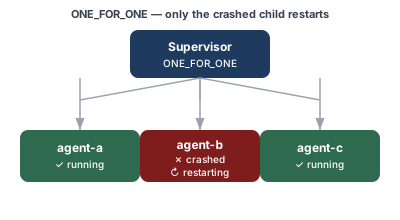
Use when: Children are independent — a crash in one does not invalidate the state of others.
Examples: - A pool of worker agents each handling independent requests - Multiple API integrations running in parallel - Stateless agents that process one message at a time
Supervisor(
    "workers",
    strategy="ONE_FOR_ONE",
    children=[
        Worker("worker-1"),
        Worker("worker-2"),
        Worker("worker-3"),
    ],
)
ONE_FOR_ALL
When any child crashes, stop and restart all children.
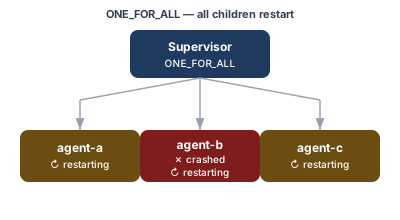
Use when: Children share mutable state or maintain synchronized positions. If one crashes, the others' state is no longer valid and they must start fresh.
Examples: - A producer and consumer that share a queue reference - A writer and a cache agent that must stay synchronized - A leader and followers in a coordinated protocol
Supervisor(
    "pipeline",
    strategy="ONE_FOR_ALL",
    children=[
        Producer("producer"),
        Consumer("consumer"),
    ],
)
REST_FOR_ONE
When a child crashes, restart that child and all children that were started after it (younger siblings). Children started earlier are unaffected.
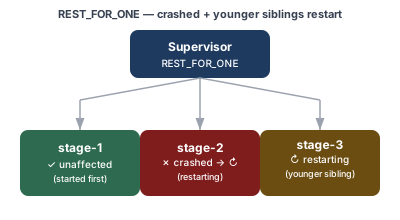
Use when: You have a pipeline where later stages depend on earlier ones. If stage-2 crashes, stage-3 is receiving invalid input and must also restart.
Examples: - Sequential processing stages: fetcher → parser → indexer - A connection stage followed by one or more dependent processing stages
Supervisor(
    "pipeline",
    strategy="REST_FOR_ONE",
    children=[
        Fetcher("fetcher"),      # if fetcher crashes, parser and indexer also restart
        Parser("parser"),        # if parser crashes, indexer also restarts
        Indexer("indexer"),      # if indexer crashes, only indexer restarts
    ],
)
Backoff policies
Between each restart attempt, the supervisor waits a calculated delay. This prevents retry storms when a downstream dependency is unavailable.
| Policy | Formula | Example (base=1.0s, attempts 1–5) |
|---|---|---|
CONSTANT |
base |
1s, 1s, 1s, 1s, 1s |
LINEAR |
base × attempt |
1s, 2s, 3s, 4s, 5s |
EXPONENTIAL |
base × 2^(attempt−1) ± jitter |
~1s, ~2s, ~4s, ~8s, ~16s |
EXPONENTIAL adds up to 25% random jitter per attempt to prevent multiple agents from retrying in lockstep.
All delays are capped at backoff_max (default 60s).
Supervisor(
    "root",
    backoff="EXPONENTIAL",
    backoff_base=0.5,    # start at 0.5s
    backoff_max=30.0,    # cap at 30s
    children=[...],
)
Choosing a policy:
- Development / tests:
CONSTANTwith a short base (e.g.backoff_base=0.1) so restarts are fast and visible. - Production with transient failures:
EXPONENTIAL— gives downstream services time to recover. - Production with predictable failures:
LINEAR— gradual back-off without the compounding of exponential.
Sliding window rate limiting
The supervisor counts crashes within a sliding time window. If max_restarts crashes occur within restart_window seconds, the supervisor escalates instead of restarting.
max_restarts=3, restart_window=60.0

t=0s   → crash 1  →  1 crash in window  →  restart
t=10s  → crash 2  →  2 crashes in window →  restart
t=20s  → crash 3  →  3 crashes in window →  restart
t=30s  → crash 4  →  4 crashes in window →  ESCALATE
But:
t=0s   → crash 1  →  1 crash in window  →  restart
t=10s  → crash 2  →  2 crashes in window →  restart
t=70s  → crash 3  →  2 crashes in window (t=0 has expired) →  restart
t=80s  → crash 4  →  3 crashes in window →  restart
The window slides continuously — it's not a fixed interval that resets.
Tuning guidance:
| Scenario | max_restarts |
restart_window |
|---|---|---|
| Transient network errors expected | 5–10 | 60s |
| Bugs should surface quickly | 2–3 | 30s |
| Long-running critical process | 3 | 300s |
| Development / testing | 10+ | 60s |
Escalation chain
When a supervisor exhausts its restart budget, it escalates to its own parent supervisor. The parent restarts the escalated child supervisor as a subtree: stop, clear its restart budget (a fresh incarnation gets a fresh intensity window), start — which restarts its children in turn. Repeated subtree failures then burn the parent's budget, and so on up the tree: blast radius grows one level at a time.
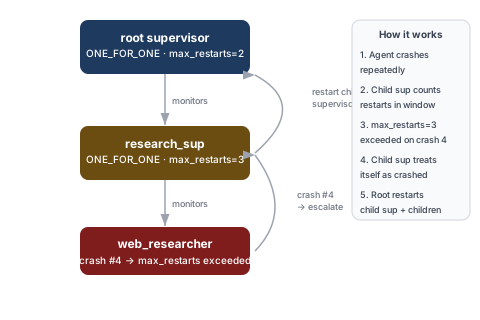
If the root supervisor also exhausts its budget, the child stays down permanently and an error is logged. There is no escalation above the root.
Crash handling is strictly serialized per supervisor (one crash processed at a time, like OTP EXIT signals): simultaneous crashes under ONE_FOR_ALL produce exactly one restart cycle, and a restart that itself fails is logged at ERROR and escalated — never silently swallowed.
Since v0.9.0, every supervisor is itself an addressable actor (see Introspection below) — escalation rides the same message-based delivery as everything else in the tree, not a private internal queue. The observable behavior above is unchanged; only the delivery mechanism is now the real thing the rest of this page describes.
The restart contract — what survives, what doesn't
A restart is a fresh incarnation (v0.9.0): a new object is built from your constructor call, and only checkpointed state is restored:
| Survives restart? | |
|---|---|
self.state you checkpointed |
✅ restored from the store |
self.state you did NOT checkpoint |
❌ reset — including whatever corruption caused the crash (that's the point of "let it crash") |
Instance variables (self.foo) |
❌ reset — a restart builds a fresh instance from your constructor call (__init__ re-runs) |
| Mailbox (queued messages) | ✅ retained; the in-flight message is lost |
| Registration (name, capabilities, metadata) | ✅ preserved exactly |
| Durable-suspension marker | ✅ rides in the checkpoint — a suspended agent restarts into SUSPENDED |
Practical rules: initialize with self.state.setdefault(...) in on_start(); call await self.checkpoint() after each completed unit of work; and give distributed trees a persistent store (sqlite/postgres) — the default InMemoryStateStore dies with the process. See Choosing your configuration.
Detecting hung agents — handle_timeout
A crash is visible; a hang (stuck await, dead socket) is not — the task never completes, so the supervisor sees a healthy child forever. The opt-in watchdog converts hangs into ordinary crashes:
On expiry, TimeoutError flows through on_error() like any exception (default ESCALATE → restart; return RETRY/SKIP to override). Limits: catches stuck awaits only — blocking code never yields and is invisible; the handler is cancelled at its current await, so hold resources with async with. Sizing guidance: recipes.
Suspension — pausing without killing
suspend/resume is the human-in-the-loop primitive: the agent pauses at its next message boundary, buffers business messages, keeps answering heartbeats (suspended ≠ crashed), and persists the marker so restarts stay suspended. resume() requires a named approver — your audit trail.
await runtime.suspend("trader", reason="daily-loss-limit")
await runtime.resume("trader", approver="risk-officer@example.com")
Override on_suspend(reason) / on_resume(approver) for resource release and pending-action pickup. ask() into a suspended agent times out by design — poll with send() for long approvals. When to reach for it: recipes.
Supervisors cannot be suspended (since v0.9.0) — a paused subtree manager would stop reacting to crashes while still holding its children hostage, so suspend() on a Supervisor raises immediately rather than silently doing something unsafe. Suspend the individual agents in the subtree instead.
Introspection — querying a supervisor's state
Since v0.9.0, every supervisor is an addressable actor — query one for a live snapshot the same way you'd ask() any agent:
reply = await runtime.ask("root", {}, message_type="civitas.supervision.status")
reply.payload
# {
#     "name": "root",
#     "strategy": "ONE_FOR_ONE",
#     "max_restarts": 3,
#     "restart_window": 60.0,
#     "crashes_in_window": 1,
#     "children": [
#         {"name": "worker", "kind": "agent", "status": "RUNNING", "restart_count": 1},
#         {"name": "child-sup", "kind": "supervisor", "status": "RUNNING", "restart_count": 0},
#     ],
# }
crashes_in_window is the engine's current intensity-window occupancy (what backoff is actually derived from, per B3 above); restart_count per child is the lifetime counter (observability only). Useful for a governance dashboard, a health-check endpoint, or a quick runtime.ask(...) from a REPL while debugging a tree.
Nested supervisors
Supervisors can contain other supervisors. This is the primary tool for building complex fault-tolerance topologies where different subsystems have different failure policies.
Runtime(
    supervisor=Supervisor(
        "root",
        strategy="ONE_FOR_ONE",
        max_restarts=2,
        children=[
            # Research subsystem — failures isolated here
            Supervisor(
                "research_sup",
                strategy="ONE_FOR_ONE",
                max_restarts=5,
                backoff="EXPONENTIAL",
                children=[
                    WebResearcher("web_researcher"),
                    DocSearcher("doc_searcher"),
                ],
            ),
            # Execution subsystem — all-or-nothing restart
            Supervisor(
                "execution_sup",
                strategy="ONE_FOR_ALL",
                max_restarts=3,
                children=[
                    ApiCaller("api_caller"),
                    DbWriter("db_writer"),
                ],
            ),
            # Standalone agent at root level
            Orchestrator("orchestrator"),
        ],
    )
)
With this tree:
web_researchercrashes →research_suprestarts it →execution_supandorchestratorunaffectedapi_callercrashes →execution_suprestarts bothapi_calleranddb_writer→research_supandorchestratorunaffectedresearch_supexhausts its budget → escalates toroot→rootrestartsresearch_sup(and its children)
From YAML:
supervision:
  name: root
  strategy: ONE_FOR_ONE
  max_restarts: 2
  children:
    - supervisor:
        name: research_sup
        strategy: ONE_FOR_ONE
        max_restarts: 5
        backoff: EXPONENTIAL
        children:
          - agent: { name: web_researcher, type: myapp.WebResearcher }
          - agent: { name: doc_searcher,   type: myapp.DocSearcher }
    - supervisor:
        name: execution_sup
        strategy: ONE_FOR_ALL
        max_restarts: 3
        children:
          - agent: { name: api_caller, type: myapp.ApiCaller }
          - agent: { name: db_writer,  type: myapp.DbWriter }
    - agent: { name: orchestrator, type: myapp.Orchestrator }
Heartbeat monitoring for remote agents
When agents run in separate OS processes (ZMQ or NATS transport), the supervisor cannot monitor them via asyncio task callbacks — the tasks are in a different process. Instead, it uses periodic liveness checks.
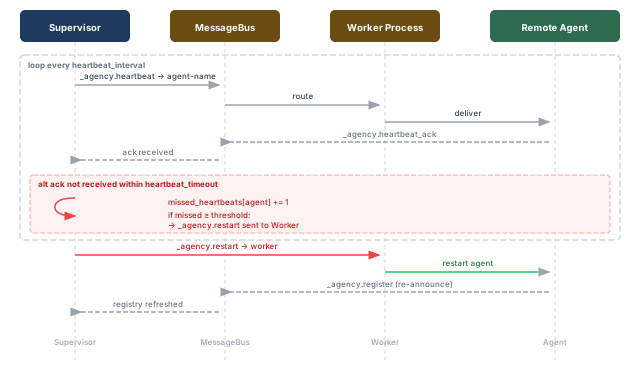
Since v0.9.0, liveness is checked per Worker process, not per agent mailbox. A supervisor sends ONE probe per interval to each Worker's process-level health channel — off that Worker's own agent mailboxes entirely — and the ack carries a snapshot for every agent hosted there (status, task_alive, mailbox_depth). This splits two questions the old per-agent scheme conflated: is the process alive (answered by the probe reaching the Worker at all) and is this specific agent healthy (answered by its entry in the snapshot). The practical result: an agent legitimately busy in a long handle() is never falsely declared crashed — the probe doesn't compete with its mailbox for attention — and a genuinely dead task is detected within one probe interval, not a full miss-threshold starvation cycle. Workers on v0.9.0+ advertise their health channel automatically; children of pre-v0.9 workers fall back to the legacy per-agent pings below (one-minor-version skew tolerance) — no configuration changes needed either way.
Heartbeat monitoring is configured per remote child via add_remote_child(), or automatically when loading a topology YAML with process: worker entries:
supervisor.add_remote_child(
    name="remote_agent",
    heartbeat_interval=5.0,        # ping every 5 seconds
    heartbeat_timeout=2.0,         # wait up to 2 seconds for ack
    missed_heartbeats_threshold=3, # restart after 3 consecutive misses
)
These same settings drive the per-process probe above when the child's Worker supports it, and the settings below describe the legacy per-agent path used for the skew fallback.
Legacy per-agent pings ride the priority channel: a busy agent acks between messages (liveness is not
conflated with queue depth), and a SUSPENDED agent acks while staying suspended. On this path only, one long
handle() still delays the ack until the next message boundary — keep
interval × threshold above your slowest legitimate handler, or bound it with
handle_timeout. Children on v0.9.0+ workers are immune to this limitation (per-process probing is off-mailbox by construction).
In YAML topology:
- agent:
    name: remote_agent
    type: myapp.RemoteAgent
    process: worker            # runs in a Worker process
    heartbeat_interval: 5.0
    heartbeat_timeout: 2.0
    missed_heartbeats_threshold: 3
The backoff and restart strategy configured on the parent supervisor apply to remote restarts too — only the detection mechanism differs.
Supervision and error actions
The supervision strategy only applies when an agent returns ErrorAction.ESCALATE from on_error(), or when on_error() itself raises an exception. Other error actions are handled inside the agent:
ErrorAction |
Who handles it | Supervisor involved? |
|---|---|---|
RETRY |
Runtime re-delivers the message | No |
SKIP |
Runtime discards the message | No |
STOP |
Runtime shuts down the agent gracefully | No |
ESCALATE |
Agent crashes → supervisor takes over | Yes |
The default on_error() returns ESCALATE. Override it when you have a meaningful retry policy:
async def on_error(self, error: Exception, message: Message) -> ErrorAction:
    if isinstance(error, RateLimitError) and message.attempt < 3:
        return ErrorAction.RETRY     # re-deliver, supervisor not involved
    if isinstance(error, ValidationError):
        return ErrorAction.SKIP      # bad message, move on
    return ErrorAction.ESCALATE      # anything else: crash and let supervisor decide
Observability
Every supervisor restart emits an OTEL span with the following attributes:
| Attribute | Value |
|---|---|
civitas.supervisor |
Supervisor name |
civitas.child |
Name of the restarted child |
civitas.restart_count |
Restart number for this child |
civitas.strategy |
ONE_FOR_ONE / ONE_FOR_ALL / REST_FOR_ONE |
civitas.error |
Exception string that caused the restart |
These spans are linked to the agent's trace, so you can see the full causal chain: which message triggered the crash, how many restarts occurred, and when the agent recovered.
Common patterns
Pattern: Fast restarts in development, conservative in production
import os

Supervisor(
    "root",
    max_restarts=10 if os.getenv("ENV") == "dev" else 3,
    restart_window=60.0,
    backoff="CONSTANT" if os.getenv("ENV") == "dev" else "EXPONENTIAL",
    backoff_base=0.05 if os.getenv("ENV") == "dev" else 1.0,
    children=[...],
)
Pattern: Isolate an unreliable integration
Put unreliable agents under their own supervisor with a generous restart budget, separate from the rest of the system:
Supervisor("root", strategy="ONE_FOR_ONE", children=[
    Supervisor(
        "flaky_api_sup",
        strategy="ONE_FOR_ONE",
        max_restarts=10,
        backoff="EXPONENTIAL",
        children=[FlakyApiAgent("flaky_api")],
    ),
    StableAgent("stable"),
])
stable is completely unaffected by however many times flaky_api crashes.
Pattern: Circuit breaker via max_restarts
Set max_restarts low on purpose to stop hammering a downstream service that is down. Let it escalate to the root, which restarts the entire subsystem after a longer backoff:
Supervisor("root", strategy="ONE_FOR_ONE", backoff="EXPONENTIAL", backoff_base=30.0, children=[
    Supervisor(
        "db_sup",
        strategy="ONE_FOR_ONE",
        max_restarts=2,        # fail fast
        restart_window=30.0,
        backoff="CONSTANT",
        backoff_base=1.0,
        children=[DbAgent("db")],
    ),
])
After 2 failures in 30 seconds, db_sup escalates to root, which waits ~30s (exponential base) before restarting the subsystem.
Dynamic supervision
Static supervision — the Supervisor class — covers processes whose identity is known at deploy time. Dynamic supervision covers processes that are created and destroyed at runtime, such as per-request workers, user sessions, or spawned research agents.
DynamicSupervisor
DynamicSupervisor is a separate class from Supervisor. It follows Erlang's design: the two are deliberately distinct because ONE_FOR_ALL and REST_FOR_ONE strategies depend on a fixed, ordered child list and lose coherence when children arrive and leave dynamically. DynamicSupervisor is always ONE_FOR_ONE.
from civitas import DynamicSupervisor, Supervisor, Runtime

dyn = DynamicSupervisor(
    name="workers",
    max_children=20,           # hard capacity limit; spawn raises SpawnError when reached
    max_total_spawns=1000,     # optional lifetime cap across all spawns
)

runtime = Runtime(supervisor=Supervisor("root", children=[orchestrator, dyn]))
Or in YAML:
supervision:
  name: root
  strategy: ONE_FOR_ONE
  children:
    - type: dynamic_supervisor
      name: workers
      config:
        max_children: 20
        max_total_spawns: 1000
    - type: agent
      name: orchestrator
      module: myapp.agents
      class: OrchestratorAgent
DynamicSupervisor starts empty. Children are added at runtime via self.spawn().
Spawning agents
Any agent that has a DynamicSupervisor as a sibling or ancestor can spawn children using self.spawn(). The runtime resolves the nearest ancestor DynamicSupervisor automatically — you don't name the target.
class OrchestratorAgent(AgentProcess):
    async def on_start(self) -> None:
        # Finds the nearest DynamicSupervisor ("workers") automatically
        name = await self.spawn(ResearchAgent, name="researcher-1")
spawn() sends a civitas.dynamic.spawn message to the DynamicSupervisor by name and awaits confirmation. It returns the agent name on success and raises SpawnError on failure (capacity reached, duplicate name, governance veto).
Despawn and stop
# Hard stop — cancels the task immediately; on_stop() still fires
await self.despawn("researcher-1")

# Soft stop — drain current message, then stop
await self.stop("researcher-1", drain="current", timeout=10.0)

# Soft stop — drain entire queue, then stop
await self.stop("researcher-1", drain="all", timeout=30.0)
stop() is awaitable and returns when the agent is fully stopped. If the agent does not stop within timeout seconds, it is force-cancelled.
Restart modes
Dynamic children have a restart_mode that controls what happens when they exit:
| Mode | Behaviour |
|---|---|
TRANSIENT (default) |
Restarted only on abnormal exit (exception). Clean exit is not restarted. |
PERMANENT |
Always restarted, regardless of how it exited. |
NEVER |
Never restarted. When it exits for any reason, the slot is freed and the spawning agent is notified. |
Pass restart_mode when spawning:
from civitas.supervisor import RestartMode

await self.spawn(WorkerAgent, name="worker-1", restart_mode=RestartMode.NEVER)
Unlike Supervisor, DynamicSupervisor does not escalate to its parent when a child exhausts its restart budget. Instead, it calls on_child_terminated() on the spawning agent.
Governance
Override on_spawn_requested() on a DynamicSupervisor subclass to implement policy checks before a spawn is committed:
class GovernedPool(DynamicSupervisor):
    async def on_spawn_requested(self, agent_class, name: str, config: dict) -> bool:
        if name in self._blocklist:
            return False           # deny
        return True                # approve
Returning False causes self.spawn() at the call site to raise SpawnError("spawn denied by governance hook").
Termination notifications
When a dynamic child exits (for any reason, including despawn or restart exhaustion), the spawning agent's on_child_terminated() hook is called:
class OrchestratorAgent(AgentProcess):
    async def on_child_terminated(self, name: str, reason: str) -> None:
        # name  — the agent that exited
        # reason — "clean_exit" | "exception" | "despawned" | "exhausted"
        logger.warning("child %s terminated: %s", name, reason)
The default implementation just logs a warning.
External API
Runtime exposes spawn, despawn, and stop_agent for external control — useful for tests or admin scripts:
await runtime.spawn("workers", ResearchAgent, name="researcher-1")
await runtime.despawn("workers", "researcher-1")
await runtime.stop_agent("workers", "researcher-1", drain="current", timeout=5.0)
TopologyAgent
TopologyAgent exposes live topology state. Declare it in YAML as a sibling of other children — the node type name (topology_server) is kept for backward compatibility, but as of v0.9.5 it no longer runs its own standalone HTTP server: instead it comes with an internally-owned HTTPGateway that serves its routes, sharing the same auth stack (API key / JWT / mTLS) as any other gateway.
Endpoints:
| Endpoint | Response |
|---|---|
GET /health |
{"status": "ok"} (auth-free by default) |
GET /topology |
Full supervision tree with live dynamic children and their statuses |
GET /agents |
Flat list of all agents including dynamically spawned ones |
GET /agents/{name} |
Single agent status or {"error": "..."} with 404 |
GET /agents/{name}/mailbox |
Non-destructive peek at a mailbox |
GET /snapshot |
JSON metrics snapshot (used by civitas top) |
GET /metrics |
Prometheus text-format exposition |
GET /processes |
Process-level resource samples |
POST /agents/{name}/suspend |
Suspend an agent |
POST /agents/{name}/resume |
Resume a suspended agent |
POST /agents/{name}/restart |
Force-restart (kill) an agent |
POST /agents/{name}/mailbox |
Inject an application message |
civitas topology show automatically pings /topology if a topology_server node is present in the YAML. If the server is unreachable (runtime not running), it falls back to rendering the static YAML tree with a (runtime not running) annotation.
See examples/dynamic_spawning.py for a complete working example.