Messaging
Agents communicate exclusively through message passing — there are no shared objects, no direct method calls between agents. This document covers every messaging primitive, how routing works under the hood, backpressure, trace propagation, and common patterns.
The three primitives
| Method | Direction | Awaits reply? | Use when |
|---|---|---|---|
self.send(name, payload) |
caller → recipient | No | Notify, trigger, emit events |
self.ask(name, payload) |
caller → recipient → caller | Yes | Need a result back |
self.broadcast(pattern, payload) |
caller → all matching | No | Fanout to a group |
All three are async, all three are available inside handle(), on_start(), and on_stop().
send — fire-and-forget
async def handle(self, message: Message) -> Message | None:
    # Notify another agent and continue immediately
    await self.send("logger", {"event": "task_started", "task_id": message.payload["id"]})
    await self.send("metrics", {"counter": "messages_processed"})
    return self.reply({"ok": True})
send returns as soon as the message is placed in the recipient's mailbox — it does not wait for the recipient to process it. If the recipient's mailbox is full, send blocks until space is available (backpressure — see below).
Optional message_type parameter:
The type field on the Message is application-defined. It flows through to the recipient's handle() as message.type, and it appears in OTEL spans. Use it to distinguish different message kinds arriving at the same agent.
ask — request-reply
async def handle(self, message: Message) -> Message | None:
    # Send and wait for a reply (default timeout: 30s)
    result = await self.ask("researcher", {"query": message.payload["topic"]})
    summary = await self.ask("summarizer", {"text": result.payload["findings"]})
    return self.reply({"report": summary.payload["summary"]})
ask suspends the calling agent until the recipient calls self.reply(...), or until the timeout expires. While suspended, the calling agent's mailbox continues to accept new messages — only this particular handle() invocation is waiting.
Timeout:
Default is 30 seconds. If the timeout expires, asyncio.TimeoutError is raised. Handle it in on_error() or inline:
try:
    result = await self.ask("service", payload, timeout=5.0)
except TimeoutError:
    return self.reply({"error": "service unavailable"})
How request-reply works under the hood
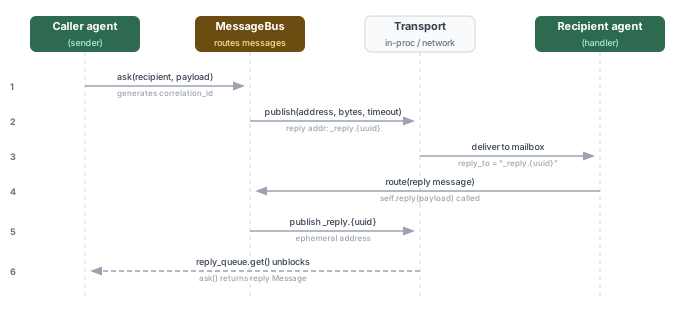
Key points:
- The transport creates a UUID-keyed ephemeral reply address per request (_reply.{uuid7})
- The reply address is injected into the request message as message.reply_to
- When the recipient calls self.reply(...), the runtime routes to that ephemeral address
- The ephemeral address is cleaned up after the reply is received or the timeout expires
- No sockets or ports are allocated per request — just a dict key in the transport
reply — responding from handle()
self.reply(payload) creates a properly wired reply Message. Return it from handle() — do not call self.send() with the reply payload directly.
async def handle(self, message: Message) -> Message | None:
    result = expensive_computation(message.payload["input"])
    return self.reply({"result": result})   # correct
reply() copies the correlation_id, trace_id, and sets recipient to message.reply_to. This is what connects the reply to the caller's waiting ask().
For fire-and-forget messages: return None (or just return) from handle(). If a caller sent with send(), there is no reply_to and no one is waiting — returning a reply would cause a routing error.
async def handle(self, message: Message) -> Message | None:
    if message.type == "notify":
        process_notification(message.payload)
        return None   # no reply needed
    return self.reply({"processed": True})
broadcast — fanout to a group
async def handle(self, message: Message) -> Message | None:
    # Send to all agents whose name matches the glob
    await self.broadcast("workers.*", {"task": message.payload["task"]})
    await self.broadcast("cache.*", {"invalidate": True})
broadcast uses glob pattern matching (fnmatch) against all registered agent names. It is fire-and-forget to each recipient — there is no way to collect replies from a broadcast. For fanout-with-collection, use parallel ask() calls instead (see patterns below).
Glob examples:
| Pattern | Matches |
|---|---|
"workers.*" |
workers.a, workers.b, workers.gpu-1 |
"*.cache" |
redis.cache, local.cache |
"agent-?" |
agent-1, agent-2 (single char wildcard) |
"*" |
Every registered agent |
The Message envelope
Every message — whether created by send, ask, or reply — is wrapped in the same Message dataclass:
@dataclass
class Message:
    # Identity
    id: str               # UUID7 — time-sortable, globally unique
    type: str             # application-defined (default: "message")

    # Routing
    sender: str           # name of the sending agent
    recipient: str        # name of the target agent
    correlation_id: str | None   # links reply → originating ask()
    reply_to: str | None         # ephemeral address for the reply

    # Your data
    payload: dict         # must contain only JSON-serializable values

    # Observability
    trace_id: str                # distributed trace identifier
    span_id: str                 # this message's own span ID
    parent_span_id: str | None   # span that caused this message

    # Runtime
    timestamp: float      # unix timestamp at creation
    attempt: int          # incremented on RETRY (starts at 0)
    priority: int         # > 0 means system message (jumps the queue)
Inside handle(), the full envelope is available:
async def handle(self, message: Message) -> Message | None:
    print(message.id)             # unique ID of this message
    print(message.type)           # e.g. "research.query"
    print(message.sender)         # who sent it
    print(message.payload)        # your data
    print(message.trace_id)       # distributed trace ID
    print(message.attempt)        # 0 on first delivery, 1+ on RETRY
Payload constraints
Payloads must contain only JSON-serializable primitives: str, int, float, bool, None, list, dict. No custom objects, no bytes, no sets.
This is enforced at Message construction time:
# Raises ValueError immediately
Message(payload={"agent": MyAgentClass()})

# Fine
Message(payload={"name": "alice", "score": 9.5, "tags": ["a", "b"]})
The constraint exists because all messages are serialized to msgpack before transport delivery, even in single-process mode. It's what makes the "swap transport without changing agent code" promise hold.
Trace context propagation
Every message carries distributed trace context — trace_id, span_id, and parent_span_id. These are set automatically by send(), ask(), and reply() based on the current message being handled. You never set them manually.
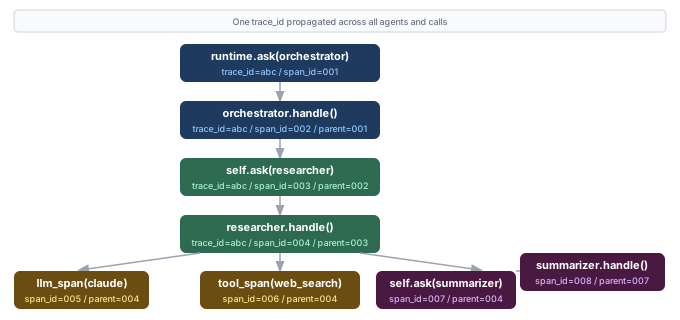
The trace_id is the same across all spans in a causal chain. When exported to Jaeger or any OTEL backend, the entire chain — across agents and process boundaries — appears as a single distributed trace.
span_id changes with every message. parent_span_id points to the span that triggered this message. Together they form the parent-child relationship that makes traces readable.
Backpressure
Every agent has a bounded mailbox (default: 1000 messages). When the mailbox is full, any send() or ask() targeting that agent blocks the caller until space is available. This is backpressure — it naturally slows producers when consumers can't keep up.
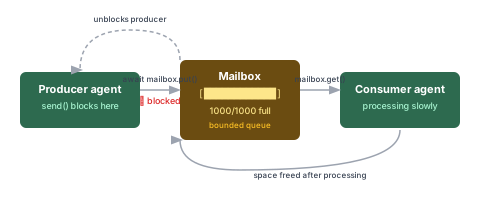
Backpressure flows through the system naturally:
Mailbox size tuning:
# Larger mailbox for agents that receive bursts
Agent("buffer", mailbox_size=5000)

# Smaller mailbox to catch runaway producers faster
Agent("controlled", mailbox_size=100)
The default (1000) is appropriate for most production workloads. Increase it for high-throughput ingestion agents, decrease it to apply stricter flow control.
System messages
Message types prefixed with _agency. are reserved for runtime internals:
| Type | Purpose |
|---|---|
_agency.heartbeat |
Supervisor pings a remote agent (legacy per-agent path, pre-v0.9 skew fallback) |
_agency.heartbeat_ack |
Remote agent confirms it is alive |
_agency.health_probe |
Supervisor pings a Worker's process-level health channel (v0.9.0 D5) |
_agency.health_ack |
Worker replies with a per-agent status/task_alive/mailbox_depth snapshot |
_agency.shutdown |
Runtime signals an agent to stop |
_agency.restart |
Supervisor tells a Worker to restart an agent |
_agency.force_restart |
Control-plane force-restart / kill (v0.9.6) — a priority message delivered outside normal restart policy |
_agency.register |
Cross-process agent registration |
_agency.deregister |
Cross-process agent deregistration |
_agency.suspend |
Request an agent pause at its next message boundary (rejected on a Supervisor, v0.9.0) |
_agency.resume |
Resume a suspended agent, carrying the approver identity |
_agency.child_crashed |
A supervisor's internal crash-processing trigger (v0.9.0 — its own mailbox now carries this instead of a bespoke queue) |
Application code must never send messages with these types. The bus will raise MessageValidationError immediately:
System messages use priority > 0, which causes them to jump ahead of normal messages in the mailbox. A shutdown signal will be processed before any queued application messages.
Routing in detail
When self.send("recipient", payload) is called, the bus resolves where to deliver it in three steps:
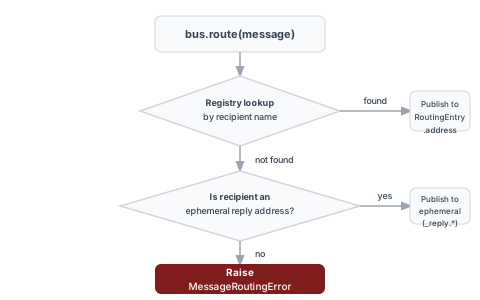
If an agent is not registered — either because it hasn't started yet or because its name is misspelled — you get a MessageRoutingError with the unknown name. This fails fast rather than silently dropping messages.
Patterns
Sequential pipeline
Chain ask() calls to pass work through stages:
class Orchestrator(AgentProcess):
    async def handle(self, message: Message) -> Message | None:
        fetched   = await self.ask("fetcher",   {"url":      message.payload["url"]})
        parsed    = await self.ask("parser",    {"html":     fetched.payload["html"]})
        summarized = await self.ask("summarizer", {"text":   parsed.payload["text"]})
        return self.reply({"summary": summarized.payload["summary"]})
Each stage runs to completion before the next starts. If any stage crashes and the supervisor restarts it, the ask() timeout determines how long the orchestrator waits.
Parallel fanout with collection
Use asyncio.gather with multiple ask() calls to run stages concurrently:
class Orchestrator(AgentProcess):
    async def handle(self, message: Message) -> Message | None:
        queries = message.payload["queries"]

        # Fan out — all three run concurrently
        results = await asyncio.gather(*[
            self.ask("researcher", {"query": q})
            for q in queries
        ])

        all_findings = [r.payload["finding"] for r in results]
        summary = await self.ask("summarizer", {"findings": all_findings})
        return self.reply({"report": summary.payload["report"]})
Each ask() suspends only for its own reply. asyncio.gather waits for all of them, collecting results as they arrive.
Dynamic routing
Route messages to different agents based on content:
class Router(AgentProcess):
    ROUTES = {
        "email":    "email_agent",
        "calendar": "calendar_agent",
        "search":   "search_agent",
    }

    async def handle(self, message: Message) -> Message | None:
        intent = message.payload.get("intent", "unknown")
        target = self.ROUTES.get(intent)

        if target is None:
            return self.reply({"error": f"unknown intent: {intent}"})

        result = await self.ask(target, message.payload)
        return self.reply(result.payload)
Broadcast + aggregate (manual)
broadcast doesn't collect replies, but you can implement fanout-with-collection manually using a shared correlation pattern:
class FanoutAgent(AgentProcess):
    async def on_start(self) -> None:
        self.state["pending"] = {}   # correlation_id → response

    async def handle(self, message: Message) -> Message | None:
        if message.type == "task":
            # Fan out to a group of workers
            workers = ["worker-1", "worker-2", "worker-3"]
            results = await asyncio.gather(*[
                self.ask(w, {"job": message.payload["job"]})
                for w in workers
            ])
            combined = [r.payload["result"] for r in results]
            return self.reply({"results": combined})
Stateful message counter
Track how many messages an agent has processed using self.state:
class Counter(AgentProcess):
    async def on_start(self) -> None:
        self.state["count"] = 0

    async def handle(self, message: Message) -> Message | None:
        self.state["count"] += 1
        return self.reply({"total": self.state["count"]})
self.state is private to this agent instance. No other agent can read or write it.
Using message.type to multiplex
A single agent can handle different message kinds by inspecting message.type:
class Worker(AgentProcess):
    async def handle(self, message: Message) -> Message | None:
        if message.type == "job.start":
            return await self._handle_start(message)
        elif message.type == "job.cancel":
            return await self._handle_cancel(message)
        elif message.type == "status.query":
            return self.reply({"status": self.state.get("current_job")})
        return None

    async def _handle_start(self, message: Message) -> Message | None:
        self.state["current_job"] = message.payload["id"]
        await self.checkpoint()
        return self.reply({"accepted": True})

    async def _handle_cancel(self, message: Message) -> Message | None:
        self.state["current_job"] = None
        return self.reply({"cancelled": True})
What you cannot do
Call another agent's methods directly. Agents are isolated — you route messages through the bus, not references.
# Wrong — agents don't hold references to each other
other_agent.handle(message)

# Right
await self.send("other-agent", payload)
Send non-serializable payloads. All values in payload must survive a msgpack round-trip.
# Wrong — dataclasses are not JSON-serializable
await self.send("agent", {"obj": MyDataclass(...)})

# Right — convert to dict first
await self.send("agent", {"obj": dataclasses.asdict(my_instance)})
Use reply() outside handle(). reply() reads self._current_message, which is only set during handle() execution.
# Wrong — called from on_start, no current message
async def on_start(self):
    return self.reply({"ready": True})  # RuntimeError

# Right — send a notification instead
async def on_start(self):
    await self.send("coordinator", {"status": "ready"})
Delivery semantics & hazards
Everything in this section is a deliberate, documented property of the runtime. Knowing these before production saves you from discovering them there.
Delivery is at-most-once
send() is fire-and-forget: no delivery confirmation, no dead-letter queue, no automatic
redelivery. The contract across failures:
| Event | Queued messages (in mailbox) | In-flight message (being handled) |
|---|---|---|
| Crash + supervisor restart | Survive — the mailbox is retained | Lost — unless on_error returned RETRY before the crash |
| Graceful stop | Drained per drain= policy (dynamic children) or dropped |
Completed first |
| Dynamic child teardown | Request-reply messages get an error reply (callers fail fast); fire-and-forget dropped with a log line | Lost |
If a message must not be lost, make its effect durable: checkpoint after processing, and design senders to re-send on missing replies (idempotency via your own message IDs).
The restart state contract (v0.8.0)
A restart is a fresh incarnation (v0.9.0): a new object is built from your constructor
call — __init__ re-runs, instance variables reset, and self.state is restored from the last
checkpoint(). Un-checkpointed anything — including whatever corruption caused the crash — dies
with the old incarnation. Queued mailbox messages carry over in order. Object references held
across a restart go stale (route by name — runtime.get_agent() always returns the current
incarnation). The durable-suspension marker rides in the checkpoint, so suspended agents restart into
SUSPENDED. Durable suspension across restarts therefore requires a StateStore (Runtime always
injects one; default is in-memory).
Retry semantics: in place, ordered
ErrorAction.RETRY re-runs handle() with the same message immediately — no mailbox
round-trip, so per-sender FIFO order holds even across transient failures. Consequences:
- Nothing else is processed between attempts (that is the ordering guarantee).
- Backoff belongs in your hook:
await asyncio.sleep(...)insideon_error()before returningRETRY. The agent is blocked while sleeping — bounded bymax_retries. - Need non-blocking deferral (e.g. a long rate-limit)? Return
SKIPand re-send the work to yourself — an explicit choice to reorder, instead of an accidental one.
The ask-cycle deadlock
Agents process one message at a time, and ask() blocks the caller's loop. If A's handler asks B
and B's handler (directly or transitively) asks A, both stall until a timeout crashes one side
— A cannot answer B while awaiting B.
Mitigations, in order of preference: keep your ask call-graph acyclic (draw it); use
send() + a reply message for back-channels instead of nested asks; set short ask timeouts on
anything that could cycle so the failure is fast and visible.
Bounded mailboxes: backpressure can deadlock too
send() to a full mailbox blocks the sender until space frees — deliberate backpressure. A
cycle of mutually-full mailboxes (A blocked sending to B, B blocked sending to A) deadlocks with
no detection. Size mailboxes for your burst profile (mailbox_size=, default 1000), keep
handle() fast relative to arrival rate, and prefer acyclic flow here too. Note the priority
queue is small (100) and reserved for system traffic. A long-SUSPENDED agent buffers business
messages until full, then back-propagates blocking to its senders — plan approval latency
accordingly.
Cooperative scheduling: what Erlang has that we don't
All agents share one event loop per process. One blocking call in handle() — time.sleep(),
synchronous HTTP, a CPU-heavy loop — stalls every agent, supervisor, heartbeat ack, and gateway
in that process. BEAM preempts; asyncio cannot. Rules: all I/O async; wrap unavoidable blocking
work in asyncio.to_thread(); move CPU-bound agents to a Worker process (see
Transports).
handle_timeout: what it can and cannot catch
The opt-in watchdog (AgentProcess(..., handle_timeout=N) or agent: {handle_timeout: N} in
YAML) converts a hung handler into a normal crash via on_error(). Limits: it fires only at
await points — a blocking hang (previous section) never yields and is undetectable; and on
expiry your handler is cancelled at its current await, so hold resources with async with.
Choose N per agent: generously above your slowest legitimate path (LLM chains included), or leave
it off for streaming agents.
Liveness vs. load (remote agents)
Heartbeats ride the priority channel: a busy remote agent acks between messages, and a
SUSPENDED agent acks while staying suspended. A single very long handle() still delays acks
until the next loop boundary — bound it with handle_timeout, and keep heartbeat thresholds
(interval × missed) above your slowest legitimate handler.