Core Concepts
This document explains the mental model behind Civitas. Read it once to understand why the pieces are shaped the way they are — the rest of the docs assume this foundation.
The OTP connection
Civitas is built on ideas borrowed from Erlang/OTP — specifically from GenServer and Supervisor. Erlang's production record over 30+ years comes not from the language itself but from two architectural ideas:
- Let it crash. Errors should not be hidden with defensive code. Let processes fail cleanly. Something else — a supervisor — is responsible for deciding what to do next.
- Hierarchical process trees. Processes are organized into trees. Each node in the tree is responsible for the health of its children. Failure propagates upward only when a node exhausts its own recovery options.
These ideas translate directly to AI agent systems. Agents crash. LLM calls fail. Tools time out. Networks partition. A runtime that treats failure as normal — rather than exceptional — produces systems that stay up.
Civitas brings these patterns to Python using asyncio, without requiring Erlang, the BEAM VM, or the JVM.
System overview
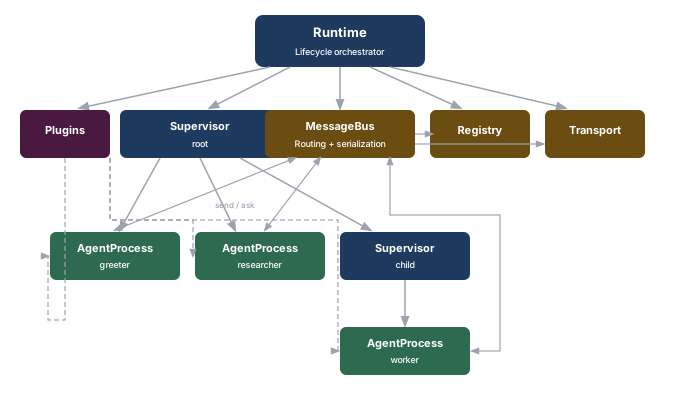
Each component has a single responsibility. Runtime assembles them; it doesn't own business logic.
AgentProcess
AgentProcess is the unit of computation — the Python equivalent of an Erlang GenServer.
For the OTP-style call/cast/info pattern itself, see GenServer below (a real subclass of
AgentProcess, not a separate primitive).
Each instance has:
- Its own mailbox — a bounded async queue of incoming messages
- Its own state — a plain dict, private to that process
- Its own error boundary — exceptions in handle() do not propagate to callers
- An asyncio Task running its message loop
Lifecycle
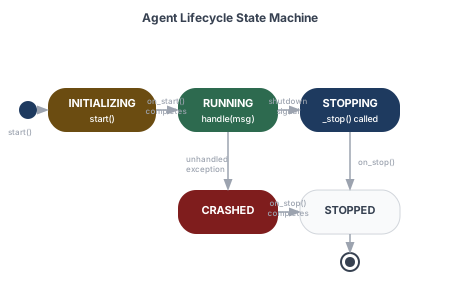
Core hooks to override (on_start, handle, on_error, on_stop shown below). Three more exist
for less common cases: on_suspend/on_resume (human-in-the-loop approval flows),
on_correction (mid-flight message correction), and on_child_terminated (a DynamicSupervisor's
own children notify their parent) — see docs/agents-guide.md and civitas/process.py for the
full signatures.
class MyAgent(AgentProcess):
    async def on_start(self) -> None:
        # Called once before the first message.
        # Initialize self.state, open connections, load models.
        self.state["counter"] = 0

    async def handle(self, message: Message) -> Message | None:
        # Called for every incoming message.
        # Return self.reply(...) for request-reply; None for fire-and-forget.
        self.state["counter"] += 1
        return self.reply({"count": self.state["counter"]})

    async def on_error(self, error: Exception, message: Message) -> ErrorAction:
        # Called when handle() raises.
        # Return what the runtime should do next.
        if isinstance(error, TransientError):
            return ErrorAction.RETRY      # re-deliver this message
        return ErrorAction.ESCALATE       # crash; let the supervisor decide

    async def on_stop(self) -> None:
        # Called on graceful shutdown — always, even on crash.
        # Close connections, flush buffers.
        pass
Error actions
ErrorAction |
Behavior |
|---|---|
RETRY |
Re-deliver the same message (up to max_retries, default 3) |
SKIP |
Discard the failed message, continue with the next |
ESCALATE |
Mark the process as CRASHED; the supervisor takes over |
STOP |
Graceful shutdown of this process only |
The default on_error returns ESCALATE. Override it only if you have a meaningful retry or skip policy.
Injected dependencies
The runtime injects four optional dependencies at startup. You don't construct them yourself:
| Attribute | Type | What it is |
|---|---|---|
self.llm |
ModelProvider |
LLM calls — await self.llm.chat(model, messages) |
self.tools |
ToolRegistry |
Tool lookup — self.tools.get("name") |
self.store |
StateStore |
State persistence — await self.checkpoint() |
self._tracer |
Tracer |
Span creation — used via llm_span() / tool_span() |
If a dependency is not configured in the Runtime, the attribute is None.
State and checkpointing
self.state is a plain dict. It is not automatically persisted. To survive a process restart:
async def handle(self, message: Message) -> Message | None:
    self.state["step"] = self.state.get("step", 0) + 1
    await self.checkpoint()   # writes self.state to the configured StateStore
    return self.reply({"step": self.state["step"]})
On restart, the runtime restores self.state from the last checkpoint before calling on_start(). Agents that never call checkpoint() incur zero overhead.
GenServer
GenServer is a real AgentProcess subclass for the classic OTP call/cast/info pattern, for
agents that are better modeled as a stateful service than a free-form message handler:
class Counter(GenServer):
    async def init(self) -> None:       # override init(), not on_start()
        self.state["count"] = 0

    async def handle_call(self, payload: dict[str, Any], from_: str) -> dict[str, Any]:
        self.state["count"] += 1
        return {"count": self.state["count"]}
Override handle_call/handle_cast/handle_info — never handle() directly — and init()
instead of on_start(). Useful whenever an agent's job is closer to "a supervised service with
request/response semantics" than "react to arbitrary messages."
Supervisor
The Supervisor monitors its children and applies a restart strategy when any of them crashes.
Supervisor(
    "root",
    strategy="ONE_FOR_ONE",   # or ONE_FOR_ALL, REST_FOR_ONE
    max_restarts=5,           # max crashes before escalating
    restart_window=60.0,      # sliding window (seconds) for counting crashes
    backoff="EXPONENTIAL",    # or CONSTANT, LINEAR
    backoff_base=1.0,         # initial backoff delay in seconds
    backoff_max=60.0,         # maximum backoff delay
    children=[
        MyAgent("agent-a"),
        MyAgent("agent-b"),
        AnotherAgent("agent-c"),
    ],
)
Restart strategies
ONE_FOR_ONE — restart only the crashed child. Other children are unaffected.
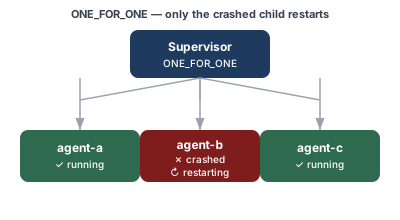
Use when children are independent of each other.
ONE_FOR_ALL — restart all children when any one crashes.
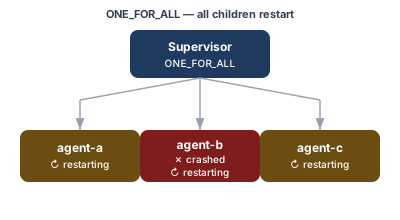
Use when children share state or must be synchronized — a crash in one means the others' state is no longer valid.
REST_FOR_ONE — restart the crashed child and all children started after it (younger siblings). Children started before are unaffected.
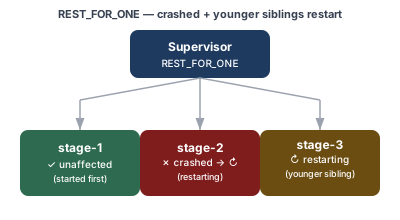
Use for pipeline-style systems where later stages depend on earlier ones — restart the broken stage and everything downstream.
Escalation
When a supervisor exceeds max_restarts within restart_window, it gives up and escalates to its own parent supervisor:
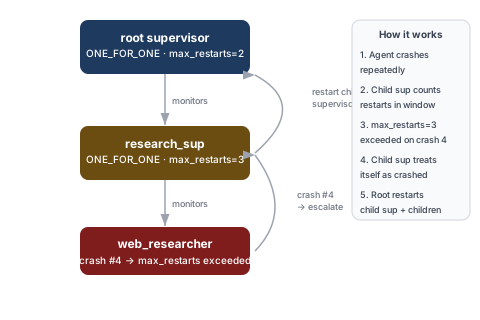
This is the tree structure working as designed: local problems are handled locally; only persistent failures propagate upward.
Backoff
Each restart attempt waits a calculated delay before starting the child:
| Policy | Formula | Example (base=1.0s) |
|---|---|---|
CONSTANT |
base |
1s, 1s, 1s, ... |
LINEAR |
base × attempt |
1s, 2s, 3s, 4s, ... |
EXPONENTIAL |
base × 2^attempt ± jitter |
1s, 2s, 4s, 8s, ... |
EXPONENTIAL is the default for production systems. It prevents retry storms when a dependency is down.
DynamicSupervisor
Supervisor's children are fixed at topology-build time. DynamicSupervisor is a real, separate
class for the opposite case — a supervisor that starts empty and gains/loses children at runtime:
class Orchestrator(AgentProcess):
    async def handle(self, message: Message) -> Message | None:
        # spawn() resolves the nearest-ancestor DynamicSupervisor automatically —
        # no need to name it, unlike spawn_into() which targets one explicitly.
        agent_name = await self.spawn(WorkerAgent, f"worker-{message.payload['job_id']}")
        # ... later ...
        await self.despawn(agent_name)
Declared in topology YAML under type: dynamic_supervisor. Enforces ONE_FOR_ONE restart
semantics only — a child exhausting its restart budget fires on_child_terminated on the spawner
rather than escalating to the tree above. spawner_allowlist/max_children/max_total_spawns
(and their per-spawner variants) are the built-in authorization/quota controls for who may spawn
what, and how much.
Message
Message is the standard envelope for all inter-agent communication. It carries routing metadata, observability context, and your application payload.
@dataclass
class Message:
    id: str               # UUID7 — time-sortable, globally unique
    type: str             # application-defined message type (default: "message")
    sender: str           # agent name that sent this message
    recipient: str        # agent name this message is addressed to
    payload: dict         # your data — must be JSON-serializable

    # Request-reply
    correlation_id: str | None   # links a reply to its originating request
    reply_to: str | None         # ephemeral address for the reply

    # Observability
    trace_id: str                # distributed trace identifier
    span_id: str                 # this message's span
    parent_span_id: str | None   # the span that caused this message

    # Runtime
    timestamp: float     # unix timestamp at creation
    attempt: int         # retry count (incremented on RETRY)
    priority: int        # > 0 for system messages (jump the queue)
    ttl: float | None    # expiry in seconds (declared field; see note below)
    seq: int | None      # sequence number for ordered delivery within a stream
ttlis real API surface (declared on everyMessage) but is not currently enforced anywhere inbus.py— setting it does not cause expiry. Documented here honestly rather than implying behavior that doesn't exist yet.
Payload rules
- Must contain only JSON-serializable values:
str,int,float,bool,None,list,dict - No custom objects, no bytes, no non-serializable types
- Validation is enforced at construction time — you'll get a
ValueErrorimmediately if the payload is invalid
This constraint exists because all messages are serialized to msgpack before delivery, even in single-process mode. It's what makes the "swap transport without changing agent code" promise hold.
System messages
Message types prefixed with _agency. are reserved for runtime internals (heartbeat, shutdown, restart, registration). Application code must never create messages with these types.
MessageBus and Registry
The MessageBus routes messages between agents. The Registry maps agent names to their delivery addresses.
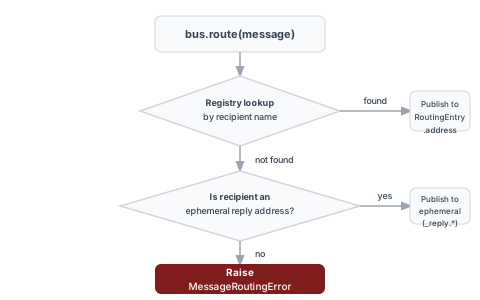
From the agent's perspective: you call self.send("other-agent", {...}) and the message arrives in other-agent's handle(). The routing layer is invisible.
The Registry is also used for pattern-matching in broadcast. A call to self.broadcast("workers.*", payload) delivers to every registered agent whose name matches the glob.
Transport
The Transport is the delivery layer underneath the MessageBus. See
Transports for the full Transport protocol
reference — kept in one place rather than duplicated here.
Three implementations are provided:

Agent code never references the transport directly. The runtime injects it. Switching from InProcessTransport to NATSTransport requires changing one line in your topology YAML.
Messages are serialized to msgpack bytes before being handed to the transport, regardless of which transport is in use. This is what enables the switch — agents send and receive the same byte format at every level.
Plugin system
Everything outside the core runtime — LLM providers, tools, state stores, observability exporters — is a plugin. Plugins are Python protocols (structural typing, not inheritance):
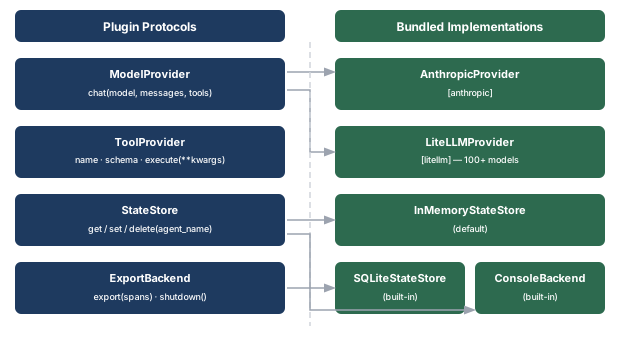
Any class that satisfies the protocol can be used — you don't subclass anything. To write a custom model provider:
class MyProvider:
    async def chat(self, model, messages, tools=None):
        # call your API here
        return ModelResponse(content="...", model=model, tokens_in=0, tokens_out=0, cost_usd=0.0)

runtime = Runtime(
    supervisor=...,
    model_provider=MyProvider(),   # satisfies ModelProvider protocol
)
See Plugins for the full protocol definitions and all bundled implementations.
Runtime
Runtime assembles all the components and manages the system lifecycle.
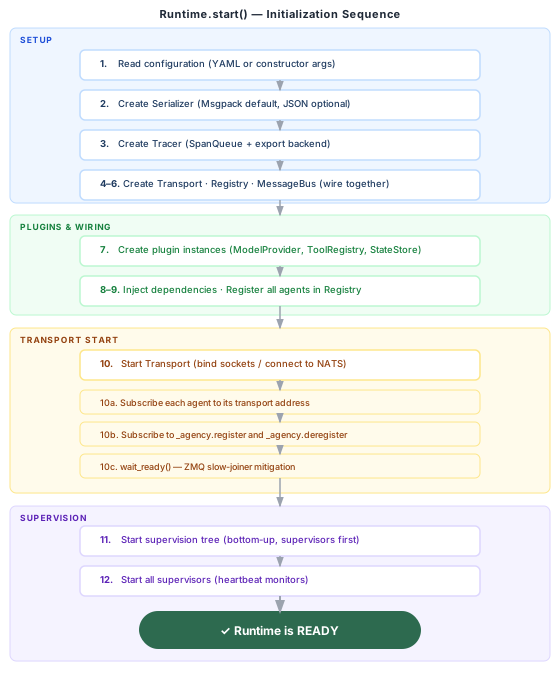
The startup sequence is deterministic: infrastructure first (serializer, tracer, transport, registry, bus), then plugins, then agents. Agents are never started before the bus is ready.
Programmatic:
runtime = Runtime(
    supervisor=Supervisor("root", children=[...]),
    transport="in_process",          # or "zmq", "nats"
    model_provider=AnthropicProvider(),
    tool_registry=tools,
    state_store=SQLiteStateStore("state.db"),
)
await runtime.start()
# ...
await runtime.stop()
From YAML topology:
See Topology YAML for the full schema.
How the pieces fit together
A complete system, traced through one message:
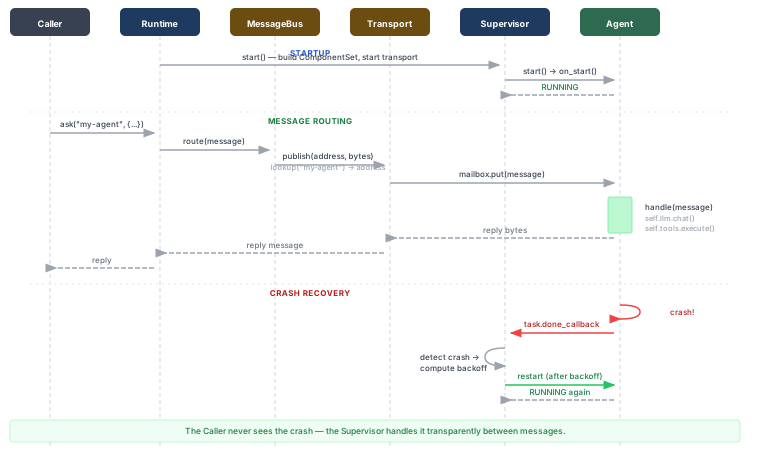
The caller never sees the crash. The supervisor handles it between messages.
What Civitas does not do
Civitas is not a framework. It does not define how agents reason, what prompts they use, or how they chain LLM calls. Those decisions belong in your handle() method.
Civitas does not replace LangGraph or CrewAI. It wraps them. A LangGraph graph runs inside an AgentProcess via the LangGraph adapter, gaining supervision and observability for free.
Civitas does not manage container scheduling. Level 4 deployment generates Docker Compose configuration. Kubernetes scheduling of those containers is outside scope — use node selectors and resource annotations for that.