Plugins
Civitas's plugin system covers everything outside the core runtime: LLM providers, tools, state stores, and observability exporters. Every plugin is a Python protocol — no base class to inherit, no registration ceremony. Any class with the right method signatures works.
Plugin overview
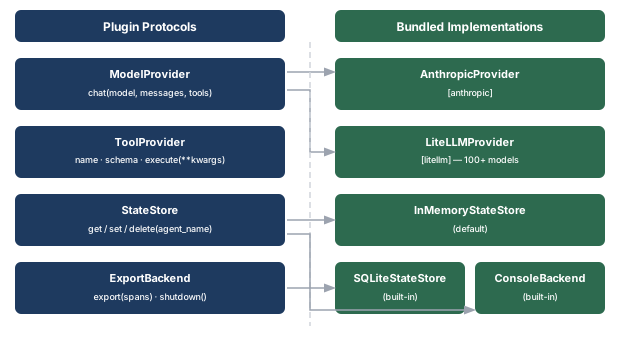
Plugins are injected by Runtime at startup. Agents access them via self.llm, self.tools, and self.store. You configure them once in Runtime(...) or topology YAML — agent code never constructs or imports plugins directly.
Install
pip install civitas                    # core only
pip install civitas-contrib[anthropic] # + Anthropic LLM provider
pip install civitas-contrib[openai]    # + OpenAI LLM provider
pip install civitas-contrib[gemini]    # + Google Gemini LLM provider
pip install civitas-contrib[mistral]   # + Mistral LLM provider
pip install civitas[otel]              # + OpenTelemetry tracing
pip install civitas[zmq]               # + ZMQ multi-process transport
pip install civitas[nats]              # + NATS distributed transport
pip install civitas[encryption]        # + encrypted StateStore at rest
civitas-contrib[litellm] does not yet provide a working LiteLLMProvider — see LiteLLMProvider below.
ModelProvider
Protocol
class ModelProvider(Protocol):
    async def chat(
        self,
        model: str,
        messages: list[dict[str, Any]],
        tools: list[Any] | None = None,
    ) -> ModelResponse: ...
ModelResponse carries the result:
@dataclass
class ModelResponse:
    content: str              # text content of the response
    model: str                # model ID actually used
    tokens_in: int            # input token count
    tokens_out: int           # output token count
    cost_usd: float | None    # estimated cost, or None if pricing unknown
    tool_calls: list[ToolCall] | None  # tool call requests from the model
AnthropicProvider
from civitas_contrib.plugins.anthropic import AnthropicProvider

runtime = Runtime(
    supervisor=Supervisor("root", children=[...]),
    model_provider=AnthropicProvider(
        api_key=None,                    # reads ANTHROPIC_API_KEY from env if not set
        default_model="claude-sonnet-4-6",
        max_tokens=4096,
        max_retries=3,                   # SDK-level retry with exponential backoff
    ),
)
Inside an agent:
async def handle(self, message: Message) -> Message | None:
    response = await self.llm.chat(
        model="claude-haiku-4-5-20251001",
        messages=[{"role": "user", "content": message.payload["question"]}],
    )
    # response.content     — text answer
    # response.tokens_in   — input tokens used
    # response.tokens_out  — output tokens used
    # response.cost_usd    — cost in USD (computed from known pricing)
    return self.reply({"answer": response.content})
Pass model=None to use the provider's default_model.
Supported models and pricing (built-in):
| Model | Input $/M tokens | Output $/M tokens |
|---|---|---|
claude-opus-4-6 |
$15.00 | $75.00 |
claude-sonnet-4-6 |
$3.00 | $15.00 |
claude-haiku-4-5-20251001 |
$0.80 | $4.00 |
claude-sonnet-4-5-20251001 |
$3.00 | $15.00 |
claude-3-7-sonnet-20250219 |
$3.00 | $15.00 |
claude-3-5-sonnet-20241022 |
$3.00 | $15.00 |
claude-3-5-haiku-20241022 |
$0.80 | $4.00 |
claude-3-opus-20240229 |
$15.00 | $75.00 |
claude-3-sonnet-20240229 |
$3.00 | $15.00 |
claude-3-haiku-20240307 |
$0.25 | $1.25 |
For models not in the pricing table, cost_usd is None.
OpenAIProvider
from civitas_contrib.plugins.openai import OpenAIProvider

runtime = Runtime(
    supervisor=Supervisor("root", children=[...]),
    model_provider=OpenAIProvider(default_model="gpt-4o"),
)
GeminiProvider
from civitas_contrib.plugins.gemini import GeminiProvider

runtime = Runtime(
    supervisor=Supervisor("root", children=[...]),
    model_provider=GeminiProvider(default_model="gemini-2.0-flash"),
)
MistralProvider
from civitas_contrib.plugins.mistral import MistralProvider

runtime = Runtime(
    supervisor=Supervisor("root", children=[...]),
    model_provider=MistralProvider(default_model="mistral-large-latest"),
)
Agent code is identical regardless of which provider is configured — only the Runtime constructor changes.
LiteLLMProvider (not yet implemented)
civitas_contrib.plugins.litellm.LiteLLMProvider (installed via civitas-contrib[litellm], and resolvable by name as type: litellm in YAML) currently raises NotImplementedError on construction — it exists as a registered placeholder, not a working provider. Track progress at the civitas-contrib issue tracker. Until it lands, use the native AnthropicProvider/OpenAIProvider/GeminiProvider/MistralProvider above.
Writing a custom ModelProvider
Any class with a chat() method satisfying the signature works:
from civitas.plugins.model import ModelResponse

class MyProvider:
    """Custom provider wrapping a local model."""

    async def chat(
        self,
        model: str,
        messages: list[dict],
        tools: list | None = None,
    ) -> ModelResponse:
        # call your local model, API, or mock
        result = call_my_model(model, messages)
        return ModelResponse(
            content=result["text"],
            model=model,
            tokens_in=result["tokens_in"],
            tokens_out=result["tokens_out"],
            cost_usd=None,   # unknown pricing
        )

runtime = Runtime(
    supervisor=...,
    model_provider=MyProvider(),
)
No registration needed. Pass the instance directly to Runtime.
ToolProvider and ToolRegistry
Protocol
class ToolProvider(Protocol):
    @property
    def name(self) -> str: ...           # unique tool name
    @property
    def schema(self) -> dict: ...        # JSON Schema for inputs
    async def execute(self, **kwargs) -> Any: ...
Registering tools
from civitas.plugins.tools import ToolRegistry

tools = ToolRegistry()
tools.register(WebSearchTool())
tools.register(CalculatorTool())

runtime = Runtime(
    supervisor=Supervisor("root", children=[...]),
    tool_registry=tools,
)
Duplicate names raise ValueError immediately — silent overwrite would cause the wrong implementation to be called.
Using tools inside agents
class ResearchAgent(AgentProcess):
    async def handle(self, message: Message) -> Message | None:
        # Look up by name
        search = self.tools.get("web_search")
        if search is None:
            return self.reply({"error": "tool not available"})

        with self.tool_span("web_search"):
            result = await search.execute(query=message.payload["query"])

        return self.reply({"results": result})
Writing a tool
from typing import Any

class WebSearchTool:
    name = "web_search"

    schema: dict[str, Any] = {
        "name": "web_search",
        "description": "Search the web for information",
        "input_schema": {
            "type": "object",
            "properties": {
                "query": {
                    "type": "string",
                    "description": "The search query",
                },
                "max_results": {
                    "type": "integer",
                    "description": "Maximum number of results to return",
                    "default": 5,
                },
            },
            "required": ["query"],
        },
    }

    async def execute(self, **kwargs: Any) -> Any:
        query = kwargs["query"]
        max_results = kwargs.get("max_results", 5)
        # ... perform search ...
        return {"results": [...]}
The schema field follows the Anthropic tool schema format (input_schema key), and AnthropicProvider passes it straight through to the SDK. No provider currently translates it: OpenAIProvider and MistralProvider forward whatever is in tools=[...] untouched to their own chat.completions call, and OpenAI's/Mistral's APIs expect a different shape ({"type": "function", "function": {"name", "parameters", ...}}, not input_schema). If you're targeting a non-Anthropic provider, convert tool.schema to that provider's expected shape yourself before passing it to self.llm.chat(...).
Passing tools to the LLM
To let the LLM decide which tool to call (tool use / function calling):
async def handle(self, message: Message) -> Message | None:
    # Collect schemas for all registered tools
    tool_schemas = [t.schema for t in self.tools.list_tools()]

    response = await self.llm.chat(
        model="claude-sonnet-4-6",
        messages=[{"role": "user", "content": message.payload["question"]}],
        tools=tool_schemas,
    )

    # Handle tool calls requested by the model
    if response.tool_calls:
        for tc in response.tool_calls:
            tool = self.tools.get(tc.name)
            if tool:
                result = await tool.execute(**tc.input)
                # continue conversation with tool result ...

    return self.reply({"answer": response.content})
StateStore
State stores persist agent checkpoints across restarts. An agent calls await self.checkpoint() to save self.state; on restart, the runtime restores it automatically before on_start().
Protocol
class StateStore(Protocol):
    async def get(self, agent_name: str) -> dict | None: ...
    async def set(self, agent_name: str, state: dict) -> None: ...
    async def delete(self, agent_name: str) -> None: ...
InMemoryStateStore (default)
from civitas.plugins.state import InMemoryStateStore

runtime = Runtime(
    supervisor=...,
    state_store=InMemoryStateStore(),   # this is the default
)
State survives supervisor restarts within the same process lifetime. State is lost when the process exits. Suitable for development and for agents that don't require durable state.
SQLiteStateStore
from civitas.plugins.sqlite_store import SQLiteStateStore

runtime = Runtime(
    supervisor=...,
    state_store=SQLiteStateStore("agency_state.db"),
)
State is persisted to a local SQLite database as JSON. Survives process exits and machine restarts. All I/O runs in a thread executor — SQLite operations never block the asyncio event loop. SQLiteStateStore is part of core civitas (SQLite is stdlib).
Postgres / MySQL state stores (civitas-contrib)
For shared, multi-process durable state, civitas-contrib ships driver-backed stores (they need a DB driver, so they live in contrib):
from civitas_contrib.plugins.postgres_store import PostgresStateStore  # pip install civitas-contrib[postgres]
from civitas_contrib.plugins.mysql_store import MySQLStateStore        # pip install civitas-contrib[mysql]

runtime = Runtime(supervisor=..., state_store=PostgresStateStore("postgresql://user:pass@host/db"))
Or declaratively in topology YAML — type: postgres / type: mysql under plugins.state (resolved lazily; needs the matching contrib extra installed).
# The agent — unchanged regardless of which store is configured
class WorkflowAgent(AgentProcess):
    async def on_start(self) -> None:
        # self.state is already restored from the last checkpoint
        print(f"Resuming from step {self.state.get('step', 0)}")

    async def handle(self, message: Message) -> Message | None:
        self.state["step"] = self.state.get("step", 0) + 1
        self.state["last_input"] = message.payload

        await self.checkpoint()   # persist to SQLiteStateStore
        return self.reply({"step": self.state["step"]})
CLI state management:
civitas state list                  # show all agents with persisted state
civitas state clear <agent-name>    # reset an agent to a clean start
civitas state migrate <src> <dst>   # migrate state between backends (SQLite <-> Postgres)
Writing a custom StateStore
import aioredis

class RedisStateStore:
    """State store backed by Redis."""

    def __init__(self, url: str = "redis://localhost") -> None:
        self._redis = None
        self._url = url

    async def _ensure_connected(self):
        if self._redis is None:
            self._redis = await aioredis.from_url(self._url)

    async def get(self, agent_name: str) -> dict | None:
        await self._ensure_connected()
        data = await self._redis.get(f"civitas:state:{agent_name}")
        return json.loads(data) if data else None

    async def set(self, agent_name: str, state: dict) -> None:
        await self._ensure_connected()
        await self._redis.set(f"civitas:state:{agent_name}", json.dumps(state))

    async def delete(self, agent_name: str) -> None:
        await self._ensure_connected()
        await self._redis.delete(f"civitas:state:{agent_name}")

runtime = Runtime(
    supervisor=...,
    state_store=RedisStateStore("redis://my-redis:6379"),
)
Loading plugins from YAML
All plugins can be configured from the topology YAML without importing them in code:
plugins:
  models:
    - type: anthropic
      config:
        default_model: claude-sonnet-4-6
        max_tokens: 8192

  exporters:
    - type: console
    - type: sqlite            # SQLiteSpanStore (core) -- queryable telemetry store
      config:
        db_dir: ./civitas_telemetry
    # - type: postgres        # PostgresSpanStore (civitas-contrib[postgres])
    #   config: { url: !ENV TELEMETRY_DB_URL }
    # - type: mysql           # MySQLSpanStore (civitas-contrib[mysql])

  state:
    type: sqlite
    config:
      db_path: agency_state.db
The sqlite/postgres/mysql exporter types are SpanStores (B4) — durable, queryable telemetry stores (sqlite is core; postgres/mysql need the matching contrib extra). The sqlite/postgres/mysql state types are StateStores. Same names, different plugin role.
Plugin resolution order:
1. Python entrypoints — installed packages that register under civitas.model, civitas.exporter, civitas.state, or civitas.transport
2. Built-in names — models anthropic/openai/gemini/mistral/litellm (litellm is a registered placeholder, not yet implemented); exporters console/sqlite/postgres/mysql; state in_memory/sqlite/postgres/mysql/encrypted; transports in_process/zmq/nats
3. Dotted import path — e.g. myapp.plugins.MyProvider
Registering a plugin via entrypoint
To make a third-party plugin loadable by name from YAML, register it in your package's pyproject.toml:
[project.entry-points."civitas.model"]
my_provider = "mypkg.providers:MyProvider"

[project.entry-points."civitas.state"]
redis = "mypkg.stores:RedisStateStore"
After pip install mypkg, the plugin is available in YAML:
plugins:
  models:
    - type: my_provider
      config:
        api_url: https://my-api.example.com
  state:
    type: redis
    config:
      url: redis://localhost
Plugin error handling
If a plugin fails to load — missing dependency, wrong constructor args, bad import path — PluginError is raised at startup with a clear message:
civitas.errors.PluginError: Failed to load model plugin 'anthropic': No module named 'anthropic'
  Hint: pip install civitas[anthropic]
Note the hint always reads pip install civitas[<name>], even for plugins that actually live in civitas-contrib (e.g. anthropic, openai) — PluginError doesn't distinguish which package a given plugin name ships from. If the hinted extra doesn't exist on civitas, check whether the plugin is a civitas-contrib extra instead.
This fails fast at Runtime.start(), before any agents are started, so there's no ambiguity about what went wrong.