Architecture
Internal reference for contributors and advanced users. Covers the runtime startup sequence, component wiring, message flow, fault handling, and key design decisions.
Not covered on this page — real, substantial subsystems with their own dedicated docs:
civitas/gateway/ (HTTP/gRPC edge, see Gateway), civitas/dashboard/ (the civitas
top/civitas telemetry TUIs, see Observability), civitas/sandbox/ (per-MCP-server
process isolation config, see MCP), civitas/secrets/ (SecretsProvider,
substitute_vars), civitas/security/ (transport-level Ed25519 message signing), and
civitas/audit/ (AuditSink and built-in sinks).
Component map
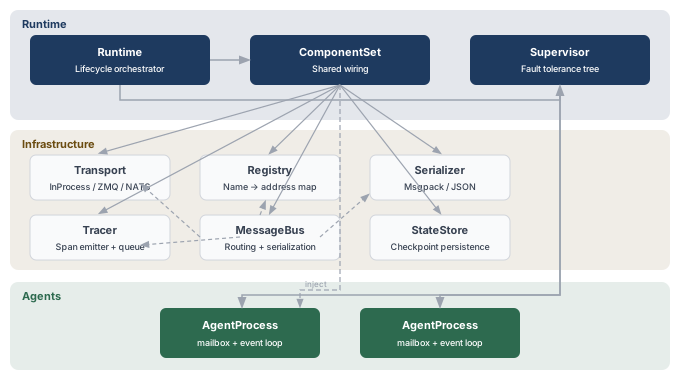
Every component except Supervisor and AgentProcess lives in ComponentSet. Runtime.start() assembles the ComponentSet, injects it into every agent, then hands control to the supervisor tree.
Runtime startup sequence
The startup sequence is defined in Runtime.start() and documented in the class docstring. Steps are in strict order — each depends on the previous.
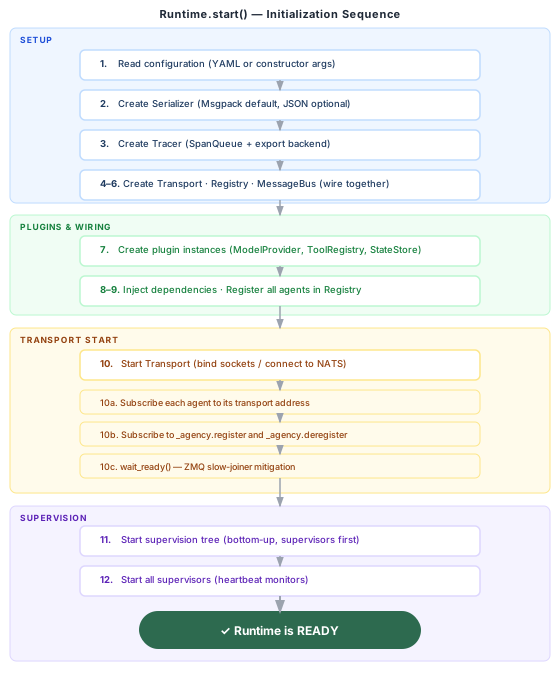
Key invariants:
- Transport is started (step 10) before agents are started (step 11) — agents begin receiving messages the moment they start, so the delivery layer must be ready first.
- All agents are registered in the Registry (step 9) before the transport subscribes them (step 10) — the Registry is the authoritative source for routing; transport subscription is mechanical delivery.
- wait_ready() (step 10d) is a ZMQ-specific delay to mitigate the ZMQ slow-joiner problem. For InProcess and NATS, wait_ready() is a no-op.
ComponentSet — shared wiring
ComponentSet is a dataclass that holds the six infrastructure objects shared by Runtime and Worker. Its __post_init__ assembles the MessageBus from its four dependencies:
@dataclass
class ComponentSet:
    transport: Transport
    registry: Registry
    serializer: Serializer
    tracer: Tracer
    store: StateStore | None
    model_provider: ModelProvider | None
    tool_registry: ToolRegistry | None
    bus: MessageBus  # built in __post_init__

    def inject(self, agent: AgentProcess) -> None:
        agent._bus = self.bus
        agent._tracer = self.tracer
        agent.llm = self.model_provider
        agent.tools = self.tool_registry
        agent.store = self.store
build_component_set() constructs a ComponentSet from primitive config values. This is called by Runtime.start() and Worker.start() when no pre-built ComponentSet is provided.
Why a separate ComponentSet? Both Runtime (the supervisor process) and Worker (a worker process) need identical infrastructure wiring. Extracting it into ComponentSet means the wiring logic is written once and tested once — neither Runtime nor Worker constructs components directly.
Message flow — end to end
This sequence traces a single ask() from one agent to another and back.
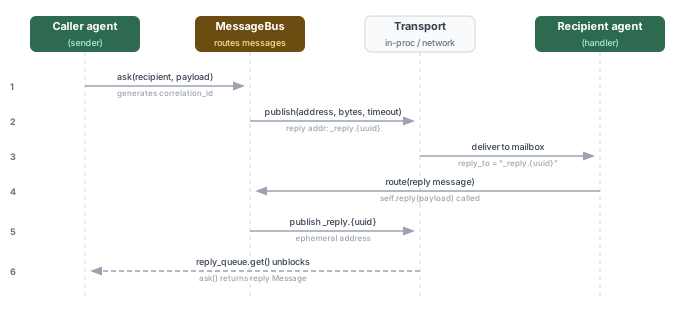
Trace propagation: The trace_id and span_id from the original message are carried in all downstream messages. bus.request() creates the initial span; every subsequent handle() creates a child span linked by parent_span_id. This chain works across process and machine boundaries because trace IDs are embedded in the serialized message payload — not in thread-local storage.
Fault handling path
When an agent's asyncio task raises an unhandled exception, control flows through the supervisor:
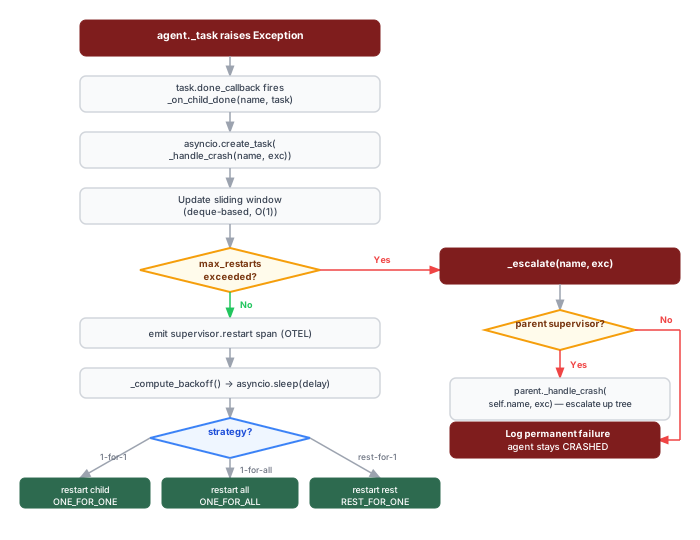
Sliding window (_restart_timestamps): A deque of crash timestamps. On each crash, the current time is appended and entries older than restart_window seconds are popped from the left. If the deque length exceeds max_restarts, the supervisor escalates. This is O(1) per crash.
Backoff computation:
def _compute_backoff(self, restart_count: int) -> float:
    if self.backoff == BackoffPolicy.CONSTANT:
        delay = self.backoff_base
    elif self.backoff == BackoffPolicy.LINEAR:
        delay = self.backoff_base * restart_count
    elif self.backoff == BackoffPolicy.EXPONENTIAL:
        delay = self.backoff_base * (2 ** (restart_count - 1))
        delay += delay * random.random() * 0.25   # 25% jitter
    return min(delay, self.backoff_max)
Jitter is added to exponential backoff to prevent all agents from thundering back simultaneously after a shared dependency recovers.
Remote agent crash: If the crashed agent is in _remote_children (a worker process), _restart_child() routes a _agency.restart message to _agency.worker.restart. The Worker process receives it and calls agent._start() locally. The supervisor continues monitoring via heartbeats.
Ephemeral reply routing
Request-reply (ask() / self.ask()) uses ephemeral addresses that exist only for the duration of a single request. The implementation differs per transport but the interface is uniform.
InProcessTransport:
The transport creates a temporary asyncio.Queue keyed by a UUID. The request message is delivered to the recipient's subscription. When the recipient calls self.reply(), the reply is routed to the ephemeral address (_reply.{uuid}). The transport's has_reply_address() returns True for this UUID, so the bus routes directly to the queue. The caller's transport.request() awaits the queue with a timeout.
ZMQTransport:
A unique reply topic (_reply.{uuid}) is subscribed before publishing the request. The reply message carries this topic as the recipient. ZMQ delivers the reply via the XSUB/XPUB proxy to the waiting subscription. The subscription is torn down after the reply arrives or the timeout fires.
NATSTransport:
NATS has built-in request-reply support via inbox subjects (_INBOX.{id}). The nats-py client handles creation and cleanup of the ephemeral subscription automatically.
Routing resolution in MessageBus.route():
1. Registry.lookup(recipient)        → use RoutingEntry.address
2. Transport.has_reply_address()     → publish directly (same-process reply)
3. recipient.startswith("_reply.")   → publish directly (cross-process reply)
4. None of the above                 → raise MessageRoutingError
The distinction between cases 2 and 3 matters for ZMQ and NATS: the reply address is registered in the transport's internal state, not in the Registry, so the Registry lookup fails. The bus falls back to transport-level routing.
Registry — name to address mapping
LocalRegistry maps agent names to RoutingEntry objects:
@dataclass
class RoutingEntry:
    name: str
    address: str       # transport address (same as name for local agents)
    is_local: bool     # True for agents in this process
For local agents, address == name. For remote agents announced via _agency.register, address is still the agent name — transport routing uses the name as the NATS subject or ZMQ topic directly.
Glob matching (registry.lookup_all("worker.*")) is used for broadcast (self.broadcast()). LocalRegistry uses Python's fnmatch for pattern matching.
Remote agent discovery: When a Worker starts, it publishes _agency.register messages for each agent it hosts. The Runtime's startup (step 10c) subscribes to this topic and calls registry.register_remote(name) for each announcement. When a Worker stops, it publishes _agency.deregister.
AgentProcess internals
Each AgentProcess runs as a single asyncio task (agent._task). Inside that task:
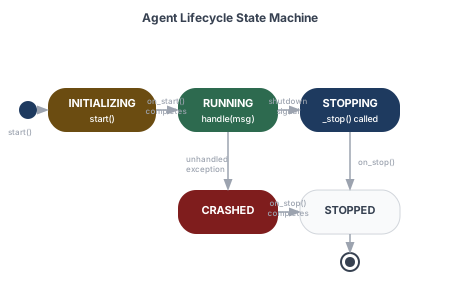
Mailbox: An asyncio.Queue with a bounded capacity (default: 1000 messages). Delivery calls put(), which blocks (awaits) when the mailbox is full — real backpressure on the sender, not a drop. (put_nowait() exists but is reserved for one sync-callback edge case — a Supervisor's own crash self-messages, which can't await — not the normal delivery path.) The agent's event loop calls get() to dequeue messages one at a time.
State restore: On INITIALIZING → RUNNING transition (inside _start()), the runtime calls store.get(agent.name) and assigns the result to self.state before on_start() runs. This means on_start() always sees the last checkpointed state, whether the agent is starting for the first time or restarting after a crash.
_max_retries: AgentProcess exposes _max_retries = 3 as a class attribute. on_error() can compare message.attempt against this to decide whether to retry or escalate. The attempt field on Message is incremented by the bus each time the message is redelivered.
Serialization
All messages — including in-process ones — are serialized. This is a deliberate design decision: it ensures that swapping from InProcessTransport to ZMQTransport or NATSTransport never requires agent code changes, because agents never rely on object identity or non-serializable types in message payloads.
MsgpackSerializer (default) is significantly faster than JSON and produces smaller payloads. JsonSerializer is available for debugging or interoperability. Both implement the same Serializer protocol:
class Serializer(Protocol):
    def serialize(self, message: Message) -> bytes: ...
    def deserialize(self, data: bytes) -> Message: ...
AGENCY_SERIALIZER=json switches to JSON at startup. Both serializers must produce identical Message objects from valid payloads.
Tracer and SpanQueue
The Tracer never blocks the message loop. Span emission goes through a SpanQueue:

If put_nowait() raises QueueFull (10,000 spans buffered), the oldest span is evicted to make room. Losing a span is always preferable to stalling the message loop.
Three output modes (selected automatically at Tracer() construction):
1. No opentelemetry-sdk → Python logging at DEBUG level
2. opentelemetry-sdk installed, no OTEL_EXPORTER_OTLP_ENDPOINT → ConsoleSpanExporter (JSON to stdout)
3. opentelemetry-sdk + OTEL_EXPORTER_OTLP_ENDPOINT set → BatchSpanProcessor + OTLP gRPC export
Runtime.stop() calls tracer.flush() which drains the SpanQueue before the process exits.
Worker process wiring
A Worker has the same ComponentSet as a Runtime — same transport, registry, serializer, tracer. The difference is that a Worker has no supervision tree. It hosts agents directly and does not manage restarts.
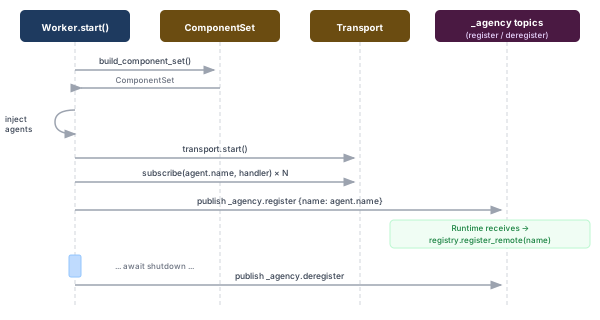
The supervisor in the main process monitors worker agents via heartbeats. When a heartbeat is missed, the supervisor sends _agency.restart → the Worker restarts the named agent locally → the agent publishes _agency.register again → the Registry entry is refreshed.
Key design decisions
Structural protocols, not base classes for plugins. ModelProvider, StateStore, ExportBackend, and Transport are all typing.Protocol classes. Any class with the right method signatures satisfies them — no inheritance, no registration. This makes plugins trivial to write and test without importing Civitas internals.
Serialize everything, even in-process. The InProcess transport still serializes messages through Msgpack. This makes transport swapping truly transparent and catches non-serializable payloads at development time rather than in production.
Jitter on exponential backoff. Without jitter, all agents that crashed simultaneously (e.g., after a shared dependency went down) would restart at exactly the same time and potentially overwhelm the dependency again. 25% random jitter spreads restarts across a window.
deque for the sliding window. The restart rate limiter uses collections.deque with O(1) append and popleft. A list would be O(n) for pop(0). At high restart rates this matters.
O(1) agent lookup. Runtime._agents_by_name and Supervisor._children_by_name are dicts built at startup. Runtime.get_agent(name) and Supervisor._find_child(name) are both O(1). A tree walk would be O(n) for every lookup.
Crash handlers as tracked tasks. _on_child_done() creates a new asyncio task for _handle_crash() and adds it to _pending_crash_tasks. Supervisor.stop() cancels all pending crash tasks before tearing down children. Without this, a crash handler could race with the shutdown sequence and attempt to restart an agent that is in the process of being stopped.
System message namespace reserved. Messages with types prefixed _agency. are reserved for internal use (_agency.heartbeat, _agency.restart, _agency.register, _agency.deregister). MessageBus.route() validates this — application code that accidentally uses the prefix gets a MessageValidationError at runtime rather than silent interference with the control plane.