Design: Civitas–Presidium Boundary
The definitive reference for what Civitas provides to Presidium, what it explicitly does not do, and where the boundary between the two layers sits.
Status: Authoritative (revised 2026-05-05) Companion: Presidium RFC-001
The One-Line Separation
Civitas: Run agents reliably. Presidium: Run agents accountably.
These are additive. A customer never chooses between a Civitas feature and a Presidium feature for the same job. Civitas is complete and useful without Presidium. Presidium is meaningless without Civitas.
What Civitas Provides
Runtime Primitives
AgentProcess— base class for all agents; mailbox, lifecycle hooks, supervision integrationSupervisor— fault-tolerant supervision trees; ONE_FOR_ONE, ONE_FOR_ALL, REST_FOR_ONEMessageBus— message routing, backpressure, ephemeral topics, request-replyStateStore— pluggable persistence protocol (InMemory, SQLite, Postgres)- Transports — InProcess, ZMQ (multi-process), NATS (distributed), with mTLS between nodes
Runtime— topology loading, plugin wiring, lifecycle orchestration
Observability & Eval
- OTEL tracing — automatic spans for agent actions, tool calls, LLM calls
AuditSink— structured audit event emission pipeline (Civitas emits; Presidium enriches and exports)EvalLoop— agent self-correction signals; internal quality feedback for agent reasoningExportBackendprotocol — pluggable telemetry export (Presidium implements Fiddler, Arize, Langfuse exporters)
Plugin Interfaces
ModelProvider— LLM calling interface; implementations: Anthropic, OpenAI, Gemini, Mistral, LiteLLMToolProvider— tool calling interface; MCP client integrationMCPClient— MCP server connectivity mechanicsStateStore— agent state persistence
Routing Registry
- Operational routing registry — maps agent names to process references and capability routing tags
- Capability routing tags — operational tags on
AgentProcessthat drivesend_capable()routing; what an agent can handle technically, not what it is authorized to do
Extension Hooks for Presidium
These are the exact surfaces Presidium uses. Civitas does not know about Presidium — it simply exposes these hooks:
| Hook | Type | What Civitas Provides |
|---|---|---|
RegistryListener |
Callback protocol | Fires on every agent register/deregister; carries agent name + capability tags |
ModelProvider protocol |
Plugin interface | chat(messages, agent_name, **kwargs) → ModelResponse |
ToolProvider protocol |
Plugin interface | Tool call interface over MCP client |
AuditSink |
Event pipeline | Structured audit events: agent name, action, message, tool, result |
ExportBackend |
Plugin interface | Telemetry export target |
EvalLoop hooks |
Attachment point | Presidium can attach governance metrics alongside self-correction signals |
| Credential context injection | credentials dict |
Passed to each agent at startup; Presidium populates it |
| Durable suspension | AgentProcess signal |
Agent can suspend awaiting an external resume signal (HITL) |
Advanced Runtime Features
GenServer— OTP-style stateful service process (supervised long-running services)- HTTP Gateway — infrastructure edge; maps HTTP requests to agent messages
- EvalLoop — agent self-correction signal infrastructure
- Fabrica (v0.5) — tool namespace, agent-as-tool composition
- Skills Gateway (v0.5) — named composable workflows
- Prompt Library (v0.5) —
PromptStoreGenServer; versioned prompt management
What Civitas Does NOT Provide
These are Presidium concerns. Do not add them to Civitas:
| Not a Civitas concern | Why | Who owns it |
|---|---|---|
| Persistent agent identity | Civitas routing registry is ephemeral (process references); no owner, version, or trust score | presidium-registry |
| Agent grants (authorization entitlements) | Capability tags are routing-only; they are not authorization concepts | presidium-registry |
| Policy enforcement (ALLOW/DENY/REQUIRE_APPROVAL) | Runtime should run agents; governance decides what they can do | presidium-policy |
| Per-agent resource governance | Rate limits, budgets, and cost tracking are governance concerns | presidium-llm-gateway |
| Credential vault | OAuth tokens, API keys scoped per (agent_id, user_id) — governance, not runtime |
presidium-registry |
| Token exchange (OBO, XAA) | Requires enterprise IdP integration; governance boundary | presidium-registry |
| Enterprise IdP integration | Civitas handles mTLS (transport); token-based auth is Presidium's job | presidium-registry |
| HITL approval routing | Approval policy and approver authentication are governance concerns | presidium-mcp-gateway |
| Trust scores | Computed from compliance signals; governance concept | presidium-registry |
| Compliance reporting | External accountability artifact; not runtime concern | presidium-audit |
| Tool ACLs | Access control based on agent grants; governance decision | presidium-mcp-gateway |
| Tool poisoning detection | Schema snapshot and change alert — governance concern | presidium-mcp-gateway |
| MCP OAuth 2.1 token acquisition | Token acquisition per MCP server endpoint is governance | presidium-mcp-gateway |
| Full LLM governance gateway | Rate limits, budgets, grant-based routing are governance | presidium-llm-gateway |
Capability Tags vs. Grants — Critical Distinction
Do not conflate these. They are different concepts at different layers.
| Concept | Layer | Meaning | Used For |
|---|---|---|---|
| Capability tag | Civitas | What an agent can handle technically | Routing: send_capable("text.summarize") dispatches to any capable agent |
| Grant | Presidium | What an agent is authorized to access | Authorization: tool:database:read allows the DB tool call |
In code:
- Civitas: AgentProcess.capabilities: list[str] — operational routing strings
- Presidium: AgentRecord.grants: list[str] — authorization entitlements (e.g. "tool:database:read", "llm:claude-sonnet", "data:customer_pii:read")
An agent may declare capabilities = ["text.summarize"] and hold zero grants. These are orthogonal.
The Eight Integration Points
How Presidium attaches to Civitas — the only surfaces that cross the boundary:
| # | Hook | Civitas Provides | Presidium Consumes |
|---|---|---|---|
| 1 | RegistryListener |
Callback on agent register/deregister | Populates AgentRecord in persistent registry |
| 2 | ModelProvider protocol |
chat() interface |
GovernedModelProvider wraps with rate limits, budgets, grant checks |
| 3 | ToolProvider protocol |
Tool call interface | GovernedToolProvider wraps with ACLs, OAuth, poisoning detection |
| 4 | AuditSink |
Structured audit event pipeline | Enriches with governance context; exports to external platforms |
| 5 | ExportBackend |
Telemetry export interface | Presidium implements Fiddler, Arize, Langfuse exporters |
| 6 | EvalLoop hooks |
Self-correction signal infrastructure | Attaches governance metrics as parallel stream (not replacement) |
| 7 | Credential context injection | credentials dict at agent startup |
Presidium populates: agent token, vault endpoint, grants |
| 8 | Durable suspension | AgentProcess awaits external signal |
Presidium HITL service sends the resume signal after approval |
Transport Security vs. Application-Level Auth
Civitas handles transport-level security: mTLS between nodes (implemented in M4.2b). Civitas does not validate application-level tokens — it does not know what OAuth is.
Presidium handles application-level authentication: token issuance, OBO exchange, credential vault, IdP integration. These operate above the transport layer.
The two are complementary: - mTLS (Civitas): proves the process connecting is who it claims to be at the network level - OAuth 2.1 Bearer tokens (Presidium): proves the agent identity is authorized to perform this specific action
CompositeModelProvider — The Residual Civitas Utility
Model routing without governance (multi-provider fallback for reliability) is a thin Civitas utility. It does not belong in Presidium because it has no governance semantics.
class CompositeModelProvider:
    """Simple ordered fallback chain. Primary → fallback on failure.
    No per-agent tracking, no rate limits, no budgets. Infrastructure only."""
The full governed gateway — per-agent rate limits, cost tracking, budget enforcement, grant-based routing — lives in presidium-llm-gateway and wraps any Civitas ModelProvider via integration point 2.
Design Principle
Civitas is designed so that governance can be added without modifying it. The extension hooks (RegistryListener, plugin protocols, AuditSink, credential context, durable suspension) are stable surfaces — Presidium attaches to them without Civitas needing to know Presidium exists.
This is the correct architecture: Civitas provides primitives; Presidium provides policy. Neither layer bleeds into the other's domain.
Presidium Architecture: Interface-First with Dual Deployment Modes
Decided: June 2026
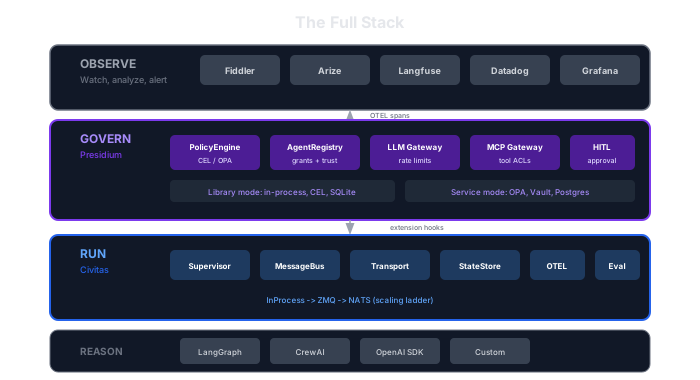
Interface-First Design
Presidium follows the same pattern as Civitas: protocols in core, implementations in contrib.
presidium(pip install presidium) — Protocol definitions only, plus lightweight defaults (CEL policy engine, in-memory registry, env-var credentials). Zero external dependencies beyond Civitas.presidium-contrib(pip install presidium-contrib[opa,vault,...]) — Adapters for existing products and reference implementations for novel components.
This replaces the earlier 6-package design (presidium-registry, presidium-policy, etc.) with a simpler 2-package structure that mirrors civitas + civitas-contrib.
CEL as Default Policy Language
The default policy engine uses CEL (Common Expression Language) — the same expression language used by Kubernetes admission policies and Google Cloud IAM.
CEL is chosen over OPA/Rego because:
- Embeddable: Evaluates in-process in microseconds. No sidecar, no HTTP call.
- Industry direction: Kubernetes is replacing OPA/Gatekeeper with CEL for admission policies.
- Simpler: Single expressions, not a full language with packages and rule heads.
- Python support: cel-python (Google's reference implementation).
OPA remains available as a presidium-contrib[opa] adapter for organisations that already run OPA infrastructure.
Library Mode vs Service Mode
Every Presidium component works in two deployment modes:
| Mode | How It Works | When to Use |
|---|---|---|
| Library | In-process Python. No network calls. Evaluates directly. | Single-process, dev, small deployments |
| Service | Civitas GenServer on the message bus, or standalone HTTP endpoint | Multi-deployment, shared state, central management |
Library mode is the complete, correct implementation — not a degraded subset. Service mode adds shared state and centralised management when the user outgrows in-process.
Example topology configuration:
# Library mode — everything in-process
presidium:
  policy:
    type: cel
    rules_path: ./policies/
  registry:
    type: sqlite
    db_path: ./presidium.db

# Service mode — components point to services
presidium:
  policy:
    type: opa
    url: http://policy-service:8181
  registry:
    type: remote
    url: http://registry-service:8080
  credentials:
    type: vault
    url: https://vault.internal:8200
Mapping to Existing Products
Where mature products exist, Presidium wraps them via adapters rather than reimplementing:
| Presidium Interface | Existing Product Adapters | Novel (Reference Impl) |
|---|---|---|
| PolicyEngine | OPA, Cedar | CEL (default, built-in) |
| CredentialProvider | HashiCorp Vault, AWS Secrets Manager | Env/File (default, built-in) |
| GovernedModelProvider | LiteLLM Proxy, Portkey | In-process grant checks (default) |
| ApprovalService | Slack, Temporal, PagerDuty | Callback (default, built-in) |
| AgentRegistry | — | Postgres-backed registry (novel) |
| GovernedToolProvider | — | MCP governance (novel) |
| TrustScorer | — | Rule-based + learning scorer (novel) |
| AuditEnricher | Datadog, Splunk, ELK (via Civitas AuditSink) | In-process enrichment (default) |
Autonomy Progression
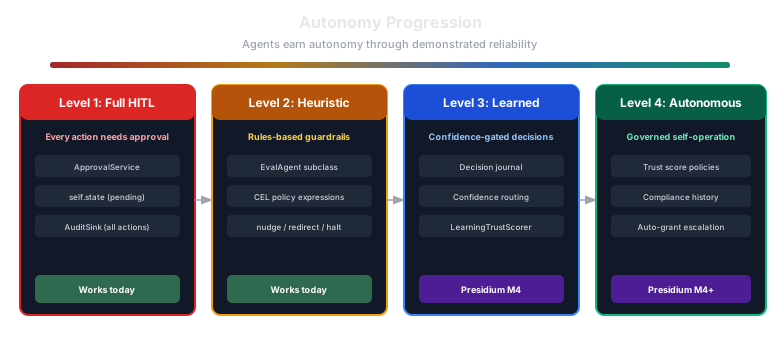
Presidium supports a graduated autonomy model:
- Full HITL — All significant actions require human approval. Uses
ApprovalServiceprotocol. - Heuristic recommendations —
EvalAgentsubclasses monitor behaviour and send corrections. CEL policies define guardrails. - Learned partial autonomy — Decision journal records approvals/rejections. Confidence-gated routing auto-approves high-confidence actions.
- Full autonomy — Trust scores, policy compliance history, and learned models enable autonomous operation within governance bounds.
Levels 1-2 work today with Civitas + Presidium interfaces. Level 3 requires the decision journal and confidence routing (M4). Level 4 requires mature trust scoring and policy learning.